Gwangbok Archive
Primary Sources
PUBLISHED EDITION · 3 NOVEMBER 2026

Proceedings of the 113th Plenary Sitting

제헌국회 제1회 제113차 본회의 회의록

Constituent National Assembly · 25 November 1948
Complete bilingual documentary edition · 14 original printed pages

Source record · Primary 07
Historical title
제헌국회 제1회 제113차 본회의 회의록
Author or issuing body
Constituent National Assembly
Original date
25 November 1948
Text used
Fourteen printed pages of the proceedings, reproduced alongside the English transcript.
Repository
National Assembly Library
Record identifier
PROC2014000113
Translation and edition
Gwangbok Archive · Haram Kim, Founder and Editor
Published
3 November 2026
Record revised
3 November 2026

Inspect the Korean source · Revision history · Report a correction

On this page · source pages and editorial material
Source record, introduction, terminology and editorial notes

SOURCE RECORD

ORIGINATING BODY National Assembly Secretariat (國會事務處)

DOCUMENT National Assembly Stenographic Record, First Session, No. 113

SITTING DATE 25 November 1948 (Dangi 4281), Thursday

SITTING HOURS 10:26 a.m. to 1:00 p.m. (12:30–12:35 p.m. recess)

SOURCE LENGTH 14 original printed pages; full text of the supplied sitting

EDITION Original Korean page facsimiles with English translation, keyed by printed page

HOLDING INSTITUTION National Assembly Library; record PROC2014000113

TRANSLATION AND EDITORIAL PREPARATION Gwangbok Archive · 2026

EDITORIAL SUMMARY

At the 113th plenary sitting, legislators debated the machinery required to investigate anti-national acts, considered the administrative offices attached to the Special Tribunal and Special Prosecution Department, and began a first reading of amendments to the Act on the Punishment of Anti-National Acts. The debate exposes disagreements about staffing, public expenditure, procedural safeguards, legislative supervision, and the distribution of investigative and prosecutorial powers.

This volume translates the session record as a parliamentary debate. Statements of members, proposed clauses and votes are not automatically equivalent to the wording of laws ultimately promulgated. Readers should compare enacted statutes separately where final legal text is at issue.

Three legislative matters in one documentary edition

01 Organization of Special Investigation Agencies for 113th Plenary Sitting — second reading (original pp. 1–11)

02 Organization of Attached Agencies of the Special Tribunal — first and subsequent readings (original pp. 11–12)

03 Amendment to the Act on the Punishment of 113th Plenary Sitting — first reading (original pp. 12–14)

Editorial principles & source verification

The Korean facsimile in each source-page section is a direct facsimile of the supplied 14-page National Assembly record. Keeping the original pages visible avoids silently regularizing historical spelling, misprints, numerals, or interruptions. The accompanying text is an English translation in the order of the original columns: left column first, followed by right column. Page boundaries are maintained even when a sentence or speech continues onto the next printed page.

Speech labels, motions, points of order, recorded votes, recesses, interruptions and the names of proposed statutes have been retained. Repetitions and procedural reversals have not been rewritten into a cleaner retrospective narrative. Names are romanized for readability; where the printed record appears inconsistent, the original Korean remains controlling and the issue is noted below.

Source provenance was cross-checked against the National Assembly Library entry for the sitting (PROC2014000113), which confirms the date, first-session numbering and listed agenda. The English rendering has been checked section by section against the selectable Korean text and the facsimile source. It should nevertheless receive a final independent Korean legal-history review before being represented as a definitive critical edition.

TRANSCRIPT VERSUS ENACTED LAW

A vote described as “inconclusive” (미결) is retained as such even when more members voted in favor than against. Where the presiding officer orders a recount, reports a rejected amendment, or announces closure of debate, the exact procedural sequence is followed. A proposal adopted during this sitting may have been revised before enactment; it is not presented here as the final statute.

TRANSLATION TERMINOLOGY

반민족행위 anti-national acts

특별조사위원회 Special Investigation Committee

특별조사위원 special investigation committee member

조사관 investigator / investigation officer

서기 clerk

서기관 senior clerk (a distinct, higher official rank)

특별재판부 Special Tribunal

특별검찰부 Special Prosecution Department

국회법 National Assembly Rules

제1·2·3독회 first / second / third reading

미결 inconclusive vote / no decision reached

Editorial notes and textual observations

1. Historical dating The cover prints both Dangi 4281 and 1948. The meeting was listed for 10:00 a.m., opened at 10:26 a.m., recessed from 12:30 to 12:35 p.m., and adjourned at 1:00 p.m. (Original pp. 1, 12, 14.)

2. Historical spelling Forms such as “읍니다” and uneven punctuation reflect the period stenographic record. These have not been emended in the facsimile or silently turned into claims about the precise spoken words.

3. Competing drafts and changing staff figures The record variously mentions 15, 20 and 30 investigators or clerical staff. On original p. 5 the clerk’s reading uses “20인 이상” (at least 20) although an earlier proposed wording on p. 2 says “20인 이내” (not more than 20). The English translations reproduce the differing reported formulations, rather than forcing consistency.

4. Clerk versus senior clerk The distinction between “서기” and “서기관” was explicitly challenged in debate (original p. 5). These are translated differently to reflect the different rank and the objection itself.

5. Bureau affairs, not affairs of state Article 2, as quoted on original p. 6, reads “국무(局務).” The supplied Chinese characters specify “affairs of the bureau/office,” not “國務” (affairs of state). The translation therefore uses “affairs of the Secretariat.”

6. Inconclusive votes The chair expressly calls several divisions “미결” (inconclusive) and conducts repeated votes (original pp. 5–6, 10). The edition does not replace those outcomes with a simple majority calculation or assume a motion passed merely because the affirmative votes outnumbered the negative.

7. Personal-name variation The record prints “초운교” on original p. 3 but “최운교” on pp. 8 and 10. It also prints “빅순석” on p. 7 but “박순석” on p. 9. These should be checked against an authoritative roster; the English page translation follows the printed forms and marks the exceptional spelling.

8. Possible character error in a historical allusion A phrase about serious crimes on original p. 4 is printed “토역(土役).” The surrounding context concerns the punishment of treason; the accompanying English translates the sense in context, without emending the source characters.

9. Additional Article 8 and later statutory text An additional oversight provision was approved during discussion on original p. 8. Later interventions challenge its placement in an organizational statute (pp. 8–11). A reader must not infer the finally promulgated law’s article count or wording solely from this interim second-reading record.

10. Proposed withdrawal of a separate Article 8 The proposal regarding staff benefits underwent inconclusive votes on withdrawal and further votes on substance before the chair declared the motion dropped (original pp. 9–10). The English edition follows each step separately.

11. Reading terminology on p. 11 A motion mentions proceeding to a third reading, whereas the presiding officer describes dispensing with the first and proceeding to the second. The edition follows the text of each speaker, rather than resolving the discrepancy without documentary evidence.

12. Nine officers on p. 12 In explaining the 16 and nine staffing limits, a speaker refers to “특별재판부에 9명,” even though the provisions distinguish tribunal secretariat staff from prosecution secretariat staff. The English marks the wording instead of silently substituting a different institution.

13. Judicial police versus prosecutorial officers On original p. 12 the proposal mentions “사법경찰관리” (judicial police officials). A passage on original p. 13 prints “사법검찰관” (judicial prosecutorial officers). This difference may be a reporting or transcription error; the translation preserves it and does not treat the words as interchangeable.

14. No final decision on the punishment-law amendment on 25 November The transcript adjourns while the first reading of the amendment to the Anti-National Acts Punishment Act is still being discussed (original p. 14). Subsequent enactment cannot be dated to this sitting on the evidence of this record alone.

Source citation & reuse

Primary source: National Assembly of the Republic of Korea, “國會速記錄 / 국회본회의 회의록,” First Session, no. 113 (25 November 1948), 14 pp., issued by the National Assembly Secretariat; National Assembly Library, PROC2014000113, https://dl.nanet.go.kr/detail/PROC2014000113.

Suggested citation: National Assembly of the Republic of Korea, “Proceedings of the 113th Plenary Sitting, 25 November 1948,” trans. Gwangbok Archive, bilingual documentary edition (2026), citing the original National Assembly Stenographic Record, First Session, no. 113, page cited.

Reuse of this translation: The English translation may be quoted, copied, and redistributed for research, teaching, publication, and other purposes, provided that users credit Gwangbok Archive and do not present the English translation as their own work. The Korean facsimiles retain their original source attribution.

READING VIEW

The Korean original is preserved as page images. Choose the bilingual view to compare each scan with its translation; select a scan to enlarge it.
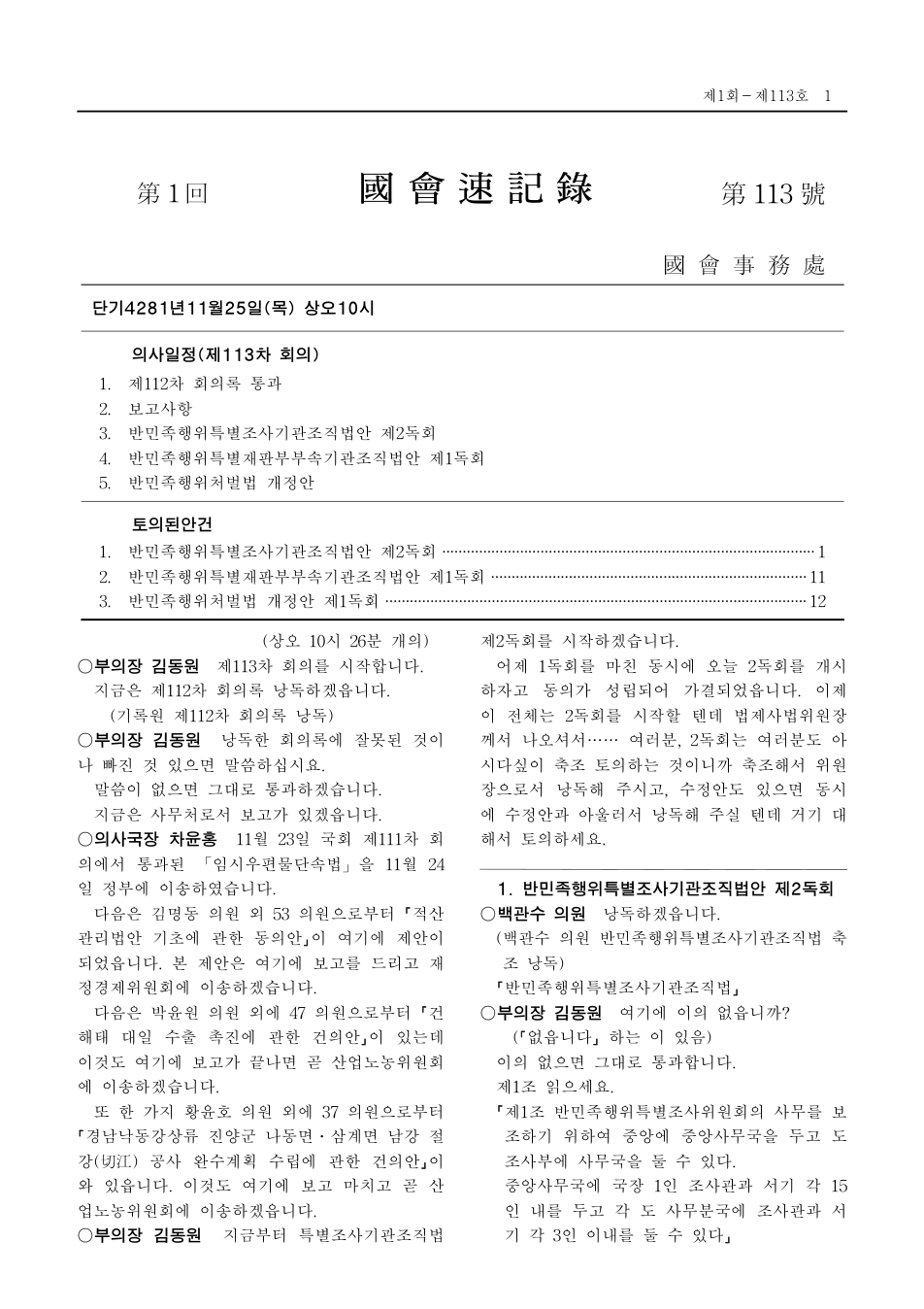
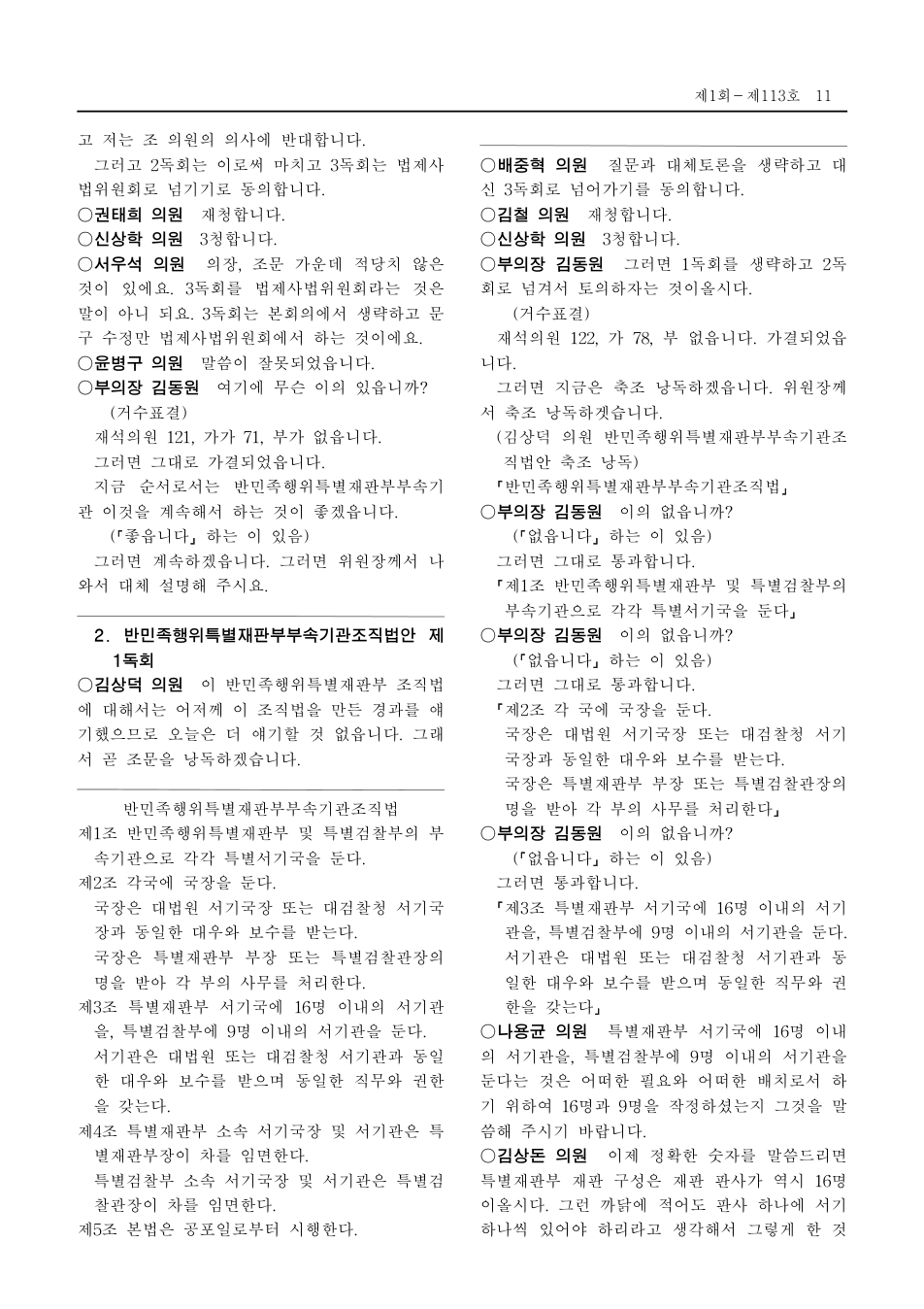
Source page 01 / 14

FIRST SESSION · NATIONAL ASSEMBLY STENOGRAPHIC RECORD · No. 113

Proceedings of the National Assembly Plenary Sitting · National Assembly Secretariat

Thursday, 25 November 1948 (Dangi year 4281), 10:00 a.m.

ORDER OF BUSINESS (113TH SITTING)

1. Approval of the minutes of the 112th sitting.

2. Reports.

3. Second reading of the Bill on the Organization of Special Investigation Agencies for Anti-National Acts.

4. First reading of the Bill on the Organization of Attached Agencies of the Special Tribunal for Anti-National Acts.

5. Bill amending the Act on the Punishment of Anti-National Acts.

MATTERS DISCUSSED

1. Second reading of the Special Investigation Agencies Organization Bill (p. 1).

2. First reading of the Special Tribunal Attached Agencies Organization Bill (p. 11).

3. First reading of the amendment to the Anti-National Acts Punishment Act (p. 12).

(The sitting opened at 10:26 a.m.)

VICE SPEAKER KIM DONG-WON: I call the 113th sitting to order. The minutes of the 112th sitting will now be read.

(The recording clerk reads the minutes of the 112th sitting.)

VICE SPEAKER KIM DONG-WON: Please speak if there are any errors or omissions in the minutes just read. If there are no comments, I shall approve them as read. There will now be a report from the Secretariat.

DIRECTOR OF PROCEEDINGS CHA YUN-HONG: The Provisional Mail Control Act, passed at the 111th sitting on 23 November, was transmitted to the Government on 24 November. Next, Representative Kim Myeong-dong and 53 other members have submitted a motion concerning the drafting of a bill on the management of vested property. After reporting it here, I shall refer it to the Finance and Economy Committee. Representative Park Yun-won and 47 other members have submitted a recommendation on promoting the export of dried laver to Japan. After this report, it too will be referred to the Industry, Agriculture and Labor Committee. Finally, Representative Hwang Yun-ho and 37 other members have submitted a recommendation to formulate a plan to complete the Nam River cutting works in Nadong and Samgye townships, Jinyang County, in the upper Nakdong River region of South Gyeongsang Province. After this report it will likewise be referred to the Industry, Agriculture and Labor Committee.

VICE SPEAKER KIM DONG-WON: We will now begin the second reading of the Special Investigation Agencies Organization Bill. Yesterday, upon concluding the first reading, a motion to proceed with the second reading today was adopted. We shall now proceed to the second reading. I ask the chair of the Legislation and Judiciary Committee to come forward. As you know, the second reading is consideration article by article. Please read each article, together with any amendments, and members may debate them.

1. SECOND READING: BILL ON THE ORGANIZATION OF SPECIAL INVESTIGATION AGENCIES FOR ANTI-NATIONAL ACTS

REPRESENTATIVE BAEK GWAN-SU: I shall read it.

(Representative Baek Gwan-su reads the Special Investigation Agencies Organization Bill article by article.)

“Act on the Organization of Special Investigation Agencies for Anti-National Acts.”

VICE SPEAKER KIM DONG-WON: Are there any objections? (Voices: “None.”) If there are no objections, it is approved as read. Read Article 1.

“Article 1. To assist with the work of the Special Investigation Committee for Anti-National Acts, a Central Secretariat shall be established at the center, and branch secretariats may be established at the provincial investigation departments. The Central Secretariat shall have one director and not more than 15 investigators and 15 clerks; each provincial branch secretariat may have not more than three investigators and three clerks.”

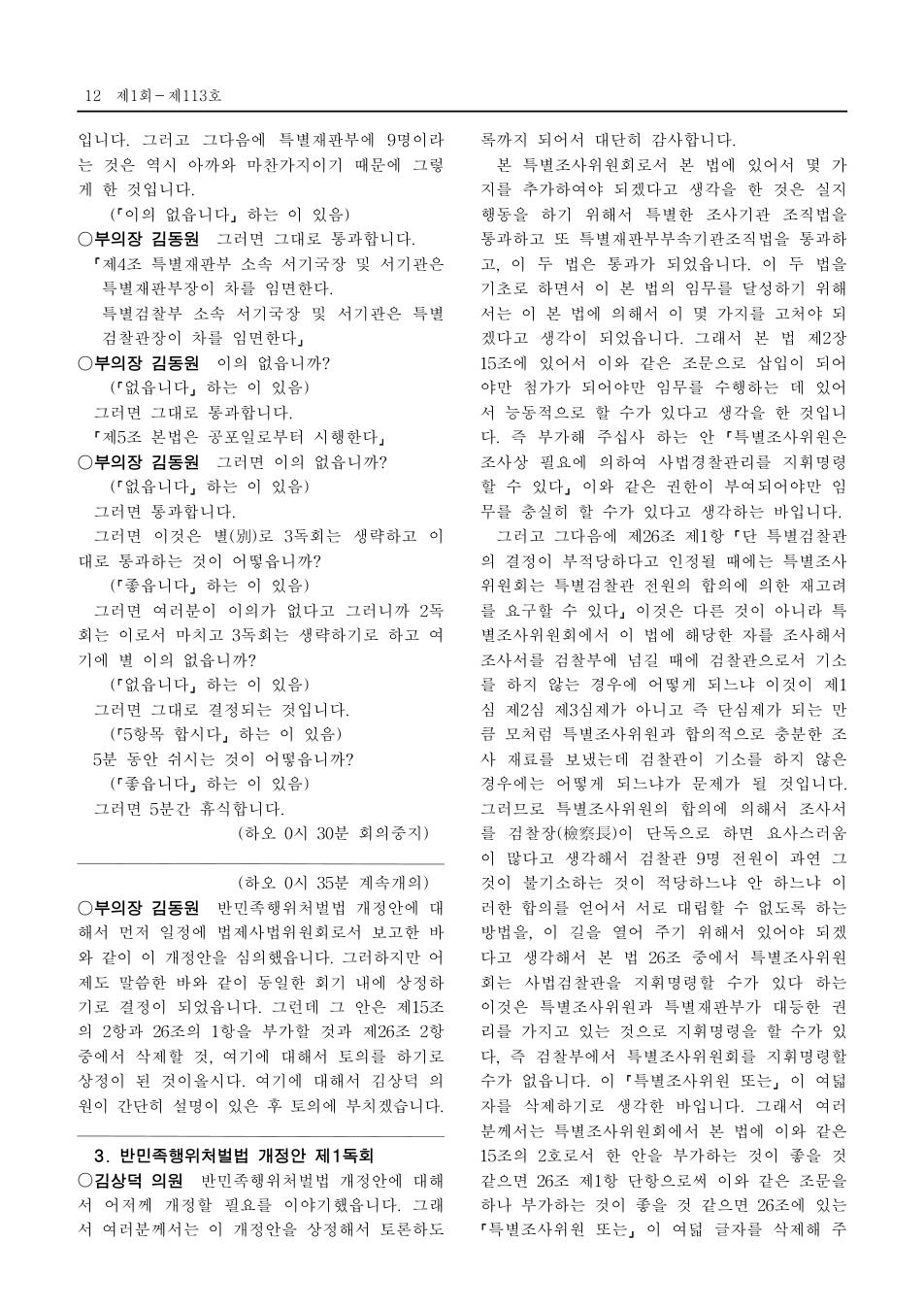
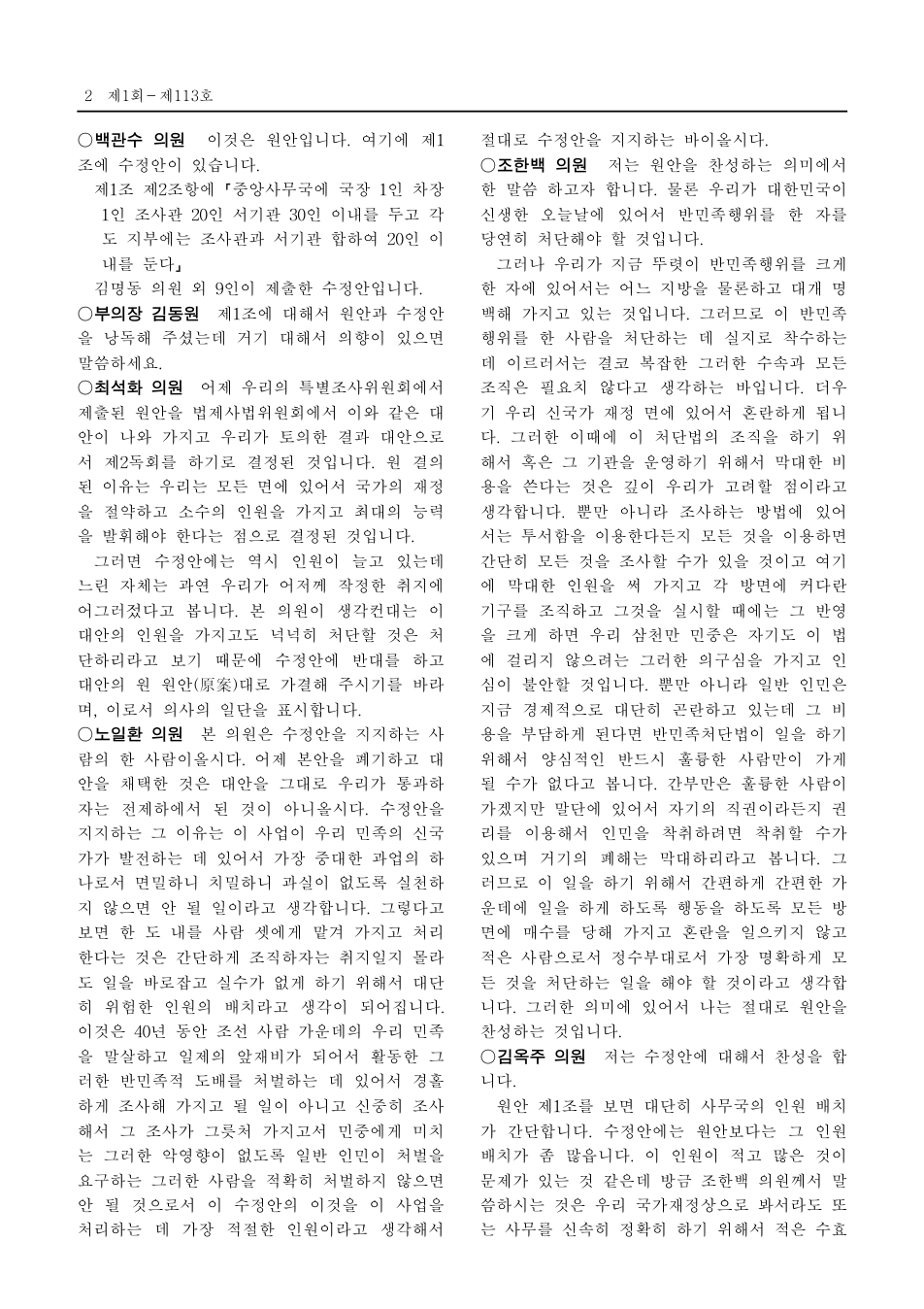
Source page 02 / 14

REPRESENTATIVE BAEK GWAN-SU: That is the original proposal. There is an amendment to Article 1, paragraph 2: “The Central Secretariat shall have one director, one deputy director, not more than 20 investigators and 30 senior clerks; each provincial branch shall have not more than 20 investigators and senior clerks in total.” This amendment was submitted by Representative Kim Myeong-dong and nine others.

VICE SPEAKER KIM DONG-WON: You have heard the original and the amendment to Article 1. Please speak if you wish to comment.

REPRESENTATIVE CHOE SEOK-HWA: Yesterday the Legislation and Judiciary Committee presented this alternative to the proposal submitted by our Special Investigation Committee. Following discussion, we decided to take the alternative to its second reading. The reason for that decision was that, in every respect, we should conserve public funds and achieve the greatest effectiveness with a small staff. The amendment, however, increases the personnel. That runs counter to the purpose we agreed yesterday. I believe the alternative provides enough personnel to punish those who must be punished. I therefore oppose the amendment and ask that the alternative, now the original text before us, be adopted. That is my position.

REPRESENTATIVE NO IL-HWAN: I am one of those supporting the amendment. Yesterday's decision to set aside the initial bill and adopt an alternative did not mean that we had undertaken to pass the alternative unchanged. I support the amendment because this is one of the most important tasks in developing our nation's new state. It must be conducted meticulously and thoroughly, without error. Entrusting an entire province to three persons might make for a simple organization, but I consider such staffing dangerously inadequate if the work is to be carried out properly and without mistakes. We are dealing with the punishment of anti-national elements who, during forty years, served as agents of Japanese imperialism and acted to destroy the Korean people. The investigations must not be superficial; they must be undertaken cautiously so that mistakes do not harm the public and those whose punishment is demanded by the people are identified and punished accurately. I regard the proposed staffing in the amendment as the most appropriate for this task, and I strongly support it.

REPRESENTATIVE JO HAN-BAEK: I wish to speak in favor of the original proposal. Naturally, now that the Republic of Korea has been established, those who committed anti-national acts should be punished. But those who committed serious anti-national acts are, in most localities, already generally well known. I do not believe elaborate procedures and organizations are necessary to begin punishing them. Moreover, the finances of our new state are in disorder. We must carefully consider spending enormous sums to establish and operate the institutions for this law. Investigations can be carried out simply, by using boxes for written denunciations and other means. If large numbers of employees and extensive agencies are organized everywhere, the thirty million people may become anxious, fearing that they themselves could fall under this law. Ordinary people are already in grave economic difficulty. If they must bear the costs, there is no guarantee that only conscientious and capable people will enter the service. Senior officials may be upstanding, but junior employees might exploit their offices or powers to extort the people, with serious consequences. We should therefore accomplish this work through a simple and compact organization, avoiding corruption and confusion, with a small, select force that can establish the facts and punish offenders. For these reasons, I firmly support the original proposal.

REPRESENTATIVE KIM OK-JU: I support the amendment. Article 1 of the original proposal provides for a very small staff in the secretariat; the amendment would increase it somewhat. The issue appears to be how many personnel are needed. Representative Jo Han-baek has just argued that, in view of national finances and the need to handle business swiftly and accurately, a small staff would be appropriate. I disagree with him on that point.

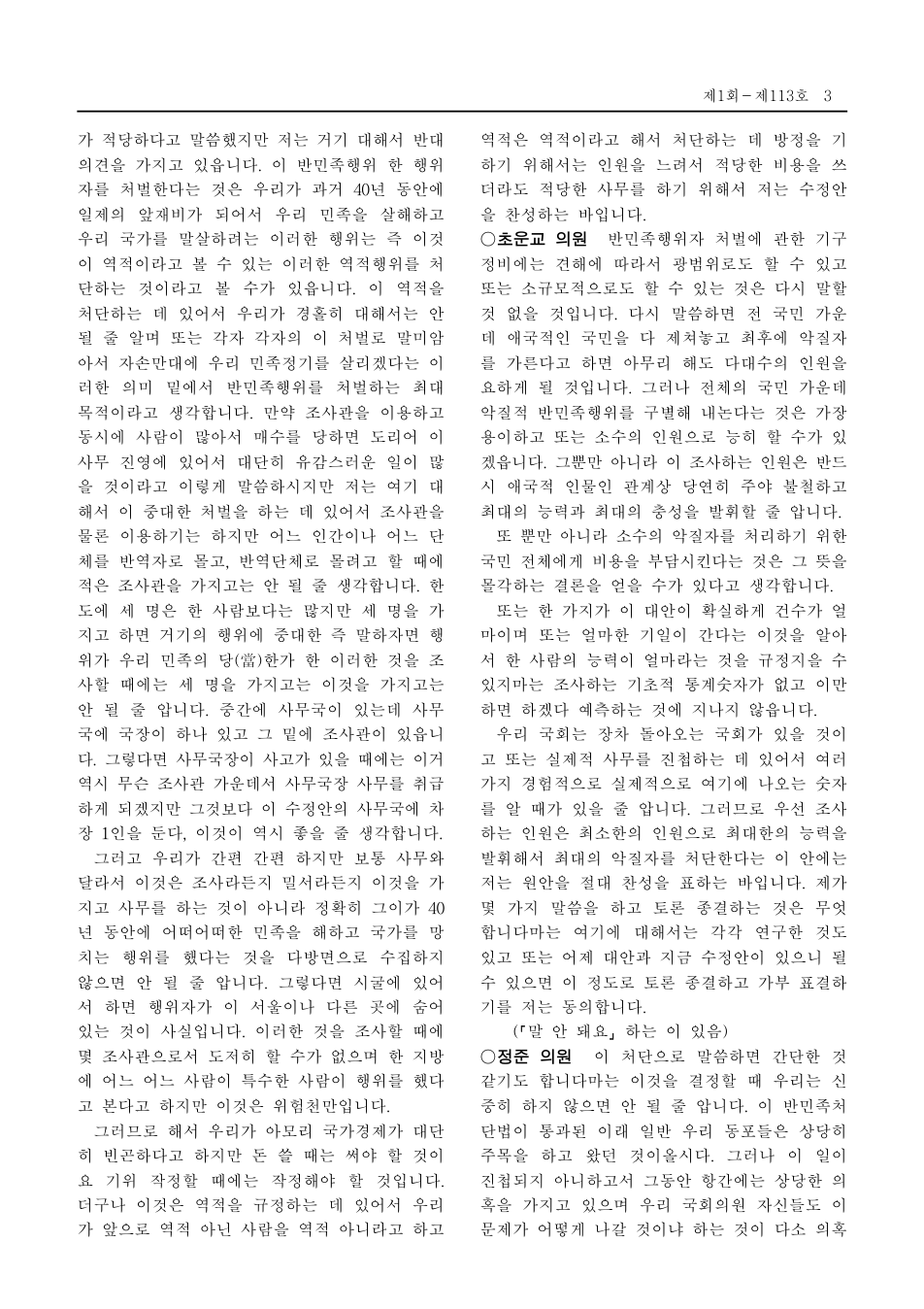
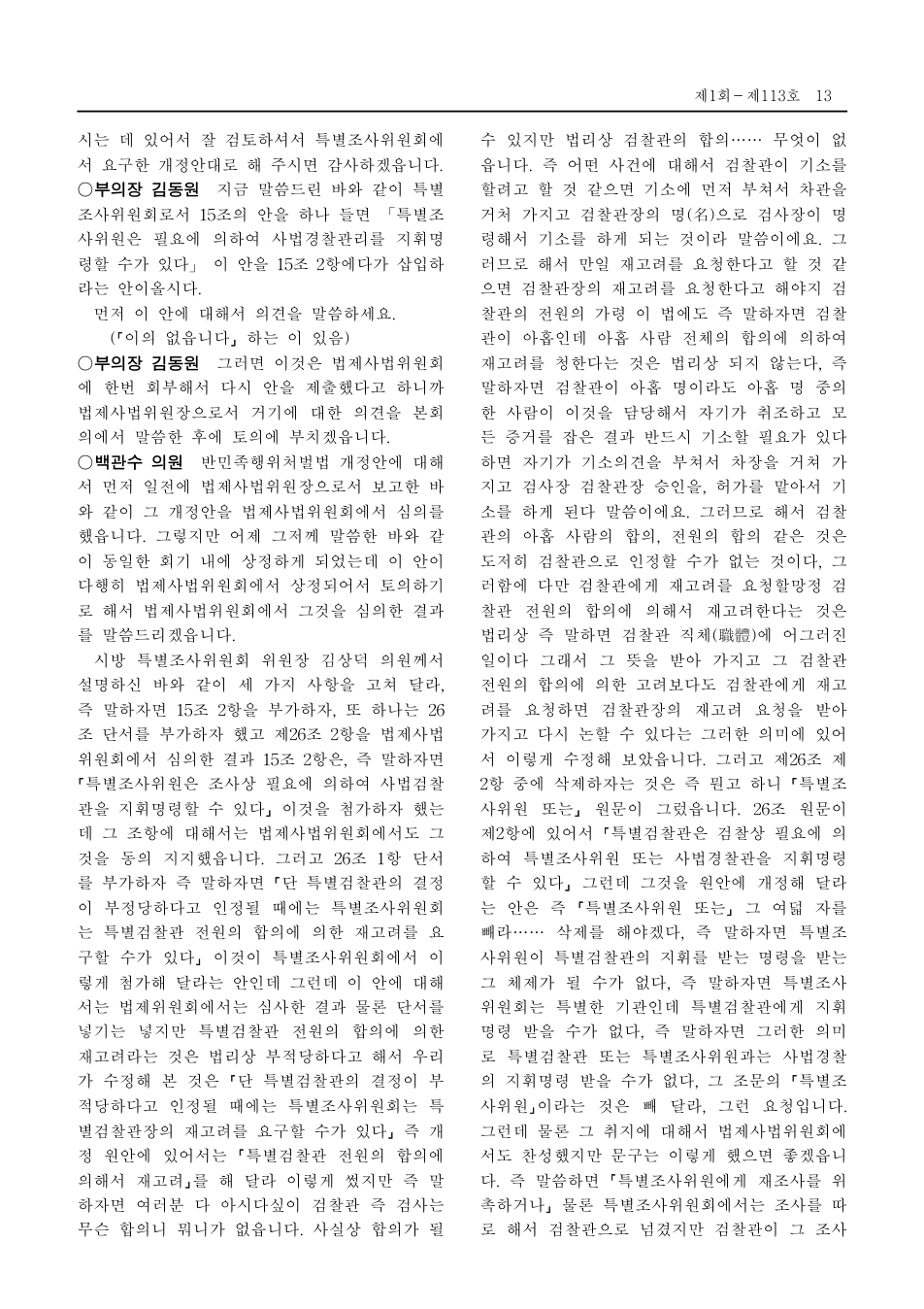
Source page 03 / 14

[Continuation of Representative Kim Ok-ju's remarks]

Punishing perpetrators of anti-national acts means punishing those whose conduct during forty years of Japanese rule served the imperial regime, killed our people, and sought to destroy our nation—conduct comparable to treason. We must not approach the punishment of such acts lightly. Its great purpose is also to sustain our national spirit for future generations. Some say that employing many investigators creates opportunities for bribery and abuse, but too few investigators are also inadequate when people or organizations are accused of treason. Three investigators per province may be more than one, but are still insufficient to establish whether conduct constituted an offense against our people. If a secretariat has only a director and investigators, an investigator will have to take over whenever the director is incapacitated. The amendment's provision for a deputy director is preferable.

This is not ordinary clerical business, to be conducted merely through reports or secret messages. Evidence must be collected from many directions about precisely what a person did over forty years to harm our people or country. A person active in one locality may be hiding in Seoul or elsewhere. A few investigators cannot deal with such cases; nor is it safe simply to accept that a certain person in a certain locality committed a particular act. Even though our national economy is impoverished, we must spend money when it is necessary. To distinguish those who are traitors from those who are not, and ensure that each is treated correctly, we need more personnel and appropriate expenditure. I therefore support the amendment.

REPRESENTATIVE CHO UN-GYO [printed 초운교; cf. 최운교 on later pages]: The machinery for punishing persons who committed anti-national acts can be extensive or small, depending on one's viewpoint. If we intend to examine the entire population and identify all the worst offenders, we might need a large staff. But identifying the worst perpetrators among the population should be relatively straightforward and can be done with few people. The investigators will necessarily be patriotic persons who, I believe, will work day and night with the greatest diligence and loyalty. It would also be wrong to make the entire population pay for the punishment of a small group of offenders.

Moreover, the proposed staff numbers are only forecasts. We have no basic statistics on the number of cases, the time each case will take, or the work one person can accomplish. A future Assembly can make adjustments when practical experience provides those figures. For the present, I firmly support the original proposal: the smallest possible staff should exert the greatest effort to punish the most serious offenders. Although I have made several points, I hesitate to call for ending the discussion myself. Still, both yesterday's alternative and today's amendment have been studied, so I move that debate now close and that we proceed to a vote.

(Voices: “That will not do!”)

REPRESENTATIVE JEONG JUN: This may appear simple, but we must decide it with care. Since the Act on the Punishment of Anti-National Acts was passed, our fellow citizens have watched closely. Yet the work has not advanced, and doubts have arisen both among the public and among members of this Assembly about how the matter will proceed.

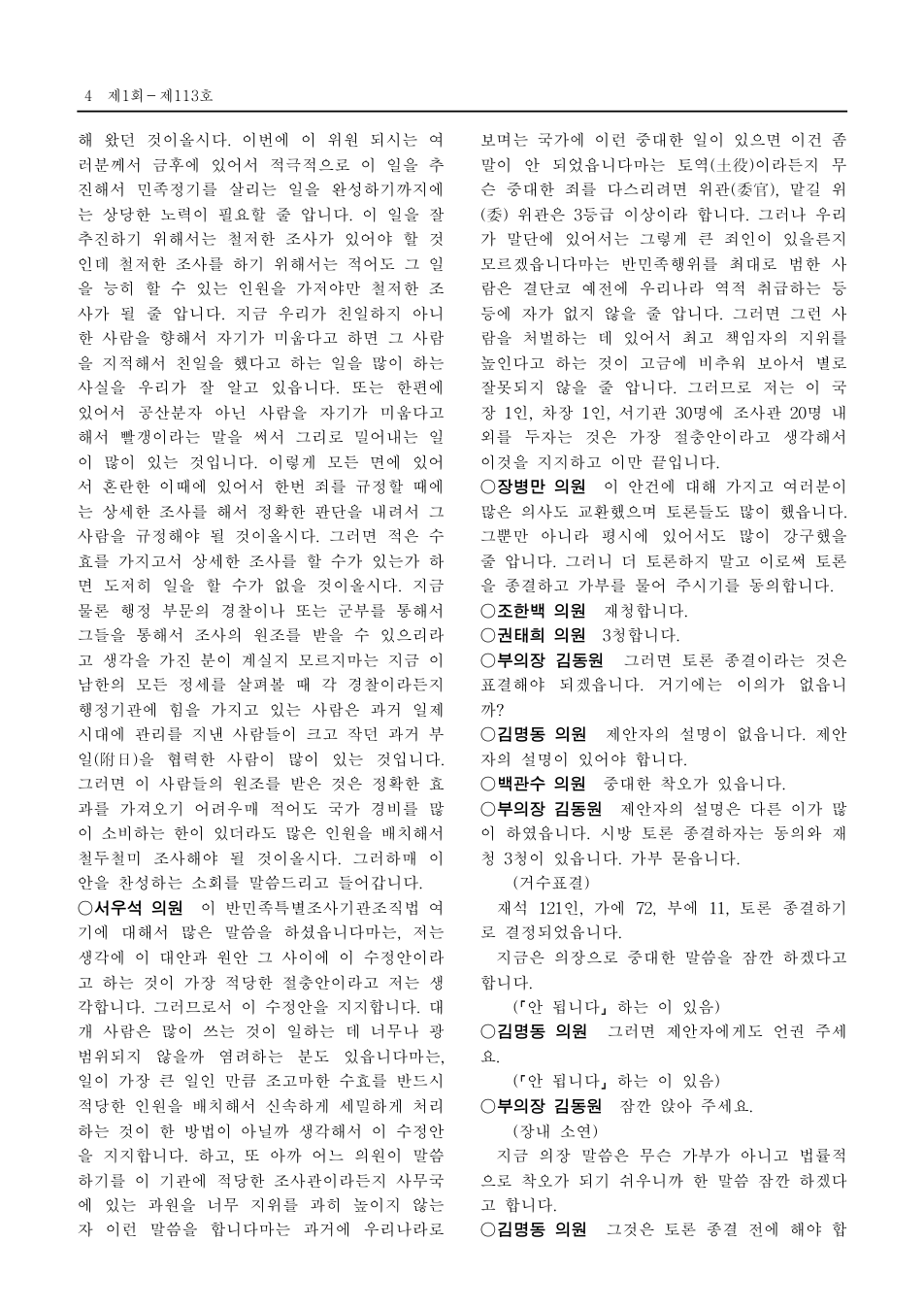
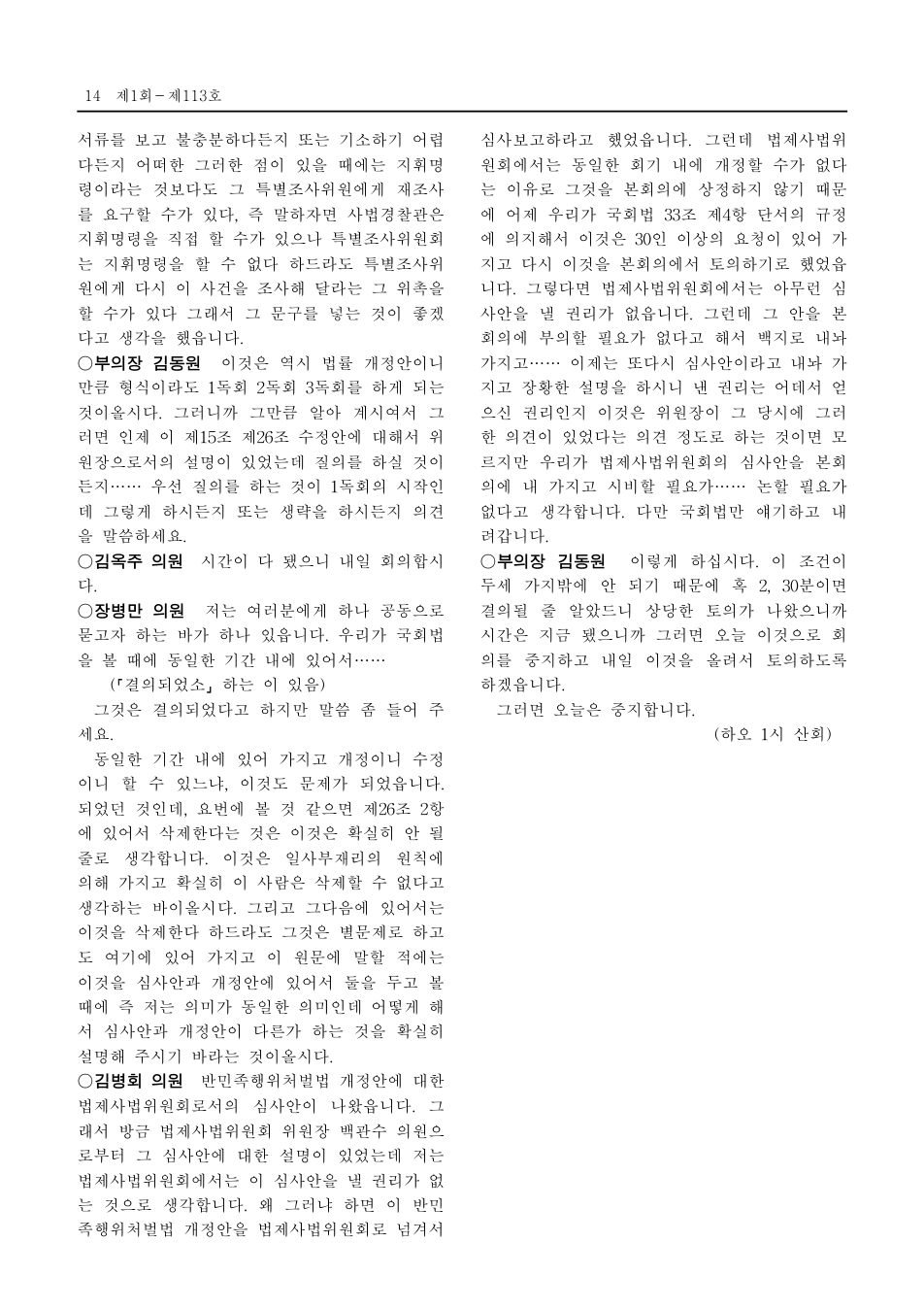
Source page 04 / 14

[Continuation of Representative Jeong Jun's remarks]

The members of the committee will have to make considerable efforts to carry this work forward and restore the national spirit. Thorough investigations will require adequate personnel. We know that people sometimes falsely accuse someone they dislike of having collaborated with Japan, or falsely label someone a communist—a “red”—because of personal hostility. In this troubled time, determining guilt demands detailed investigation and accurate judgments. A small staff cannot accomplish that. Some may suppose that the investigators can seek help from the police, administration, or military. But many persons holding influence in the police and administrative services of South Korea formerly served as officials under Japanese rule and collaborated with the Japanese in greater or lesser degree. Assistance from such people may not produce reliable results. Even if the state must spend more, we should provide enough personnel for exhaustive investigation. That is why I support the amendment.

REPRESENTATIVE SEO U-SEOK: Much has been said about the Special Investigation Agencies Organization Bill. I believe the amendment offers a suitable compromise between the other proposals, and I support it. Some fear that employing many people will make the organization too large, but given the importance of the work, assigning an appropriate—not excessive—number of employees will permit swift and careful action. As to the suggestion that investigators and secretariat officials should not hold overly high ranks, historically our country appointed officials of substantial standing to handle grave crimes such as treason. Even if not everyone we investigate is of the highest category, some of the most serious anti-national offenders may be comparable to those formerly treated as traitors. There is therefore nothing inherently improper about giving the chief officers appropriate status. A director, a deputy director, about 30 senior clerks, and 20 investigators seem to me a reasonable compromise. I support that arrangement.

REPRESENTATIVE JANG BYEONG-MAN: Members have exchanged many views and held extensive debate on this matter, including outside the chamber. I move that the debate now be closed and the question put to a vote.

REPRESENTATIVE JO HAN-BAEK: I second the motion.

REPRESENTATIVE GWON TAE-HUI: I support it as a third seconder.

VICE SPEAKER KIM DONG-WON: Closing debate requires a vote. Any objections?

REPRESENTATIVE KIM MYEONG-DONG: The proposer has not explained his amendment. He must be allowed to explain it.

REPRESENTATIVE BAEK GWAN-SU: There is a serious error.

VICE SPEAKER KIM DONG-WON: The amendment has been explained sufficiently by other speakers. There is a motion to close debate, duly seconded and supported. I put it to a vote.

(Vote by show of hands.)

Of 121 members present, 72 voted in favor and 11 against. Debate is declared closed. The chair now wishes to say something important briefly.

(Voices: “No!”)

REPRESENTATIVE KIM MYEONG-DONG: Then give the proposer the floor as well.

(Voices: “No!”)

VICE SPEAKER KIM DONG-WON: Please sit down for a moment.

(Commotion in the chamber.)

The chair does not intend to argue for or against the proposal. There is a point on which a legal misunderstanding could arise, and I wish to explain it briefly.

REPRESENTATIVE KIM MYEONG-DONG: That should have been done before debate was closed.

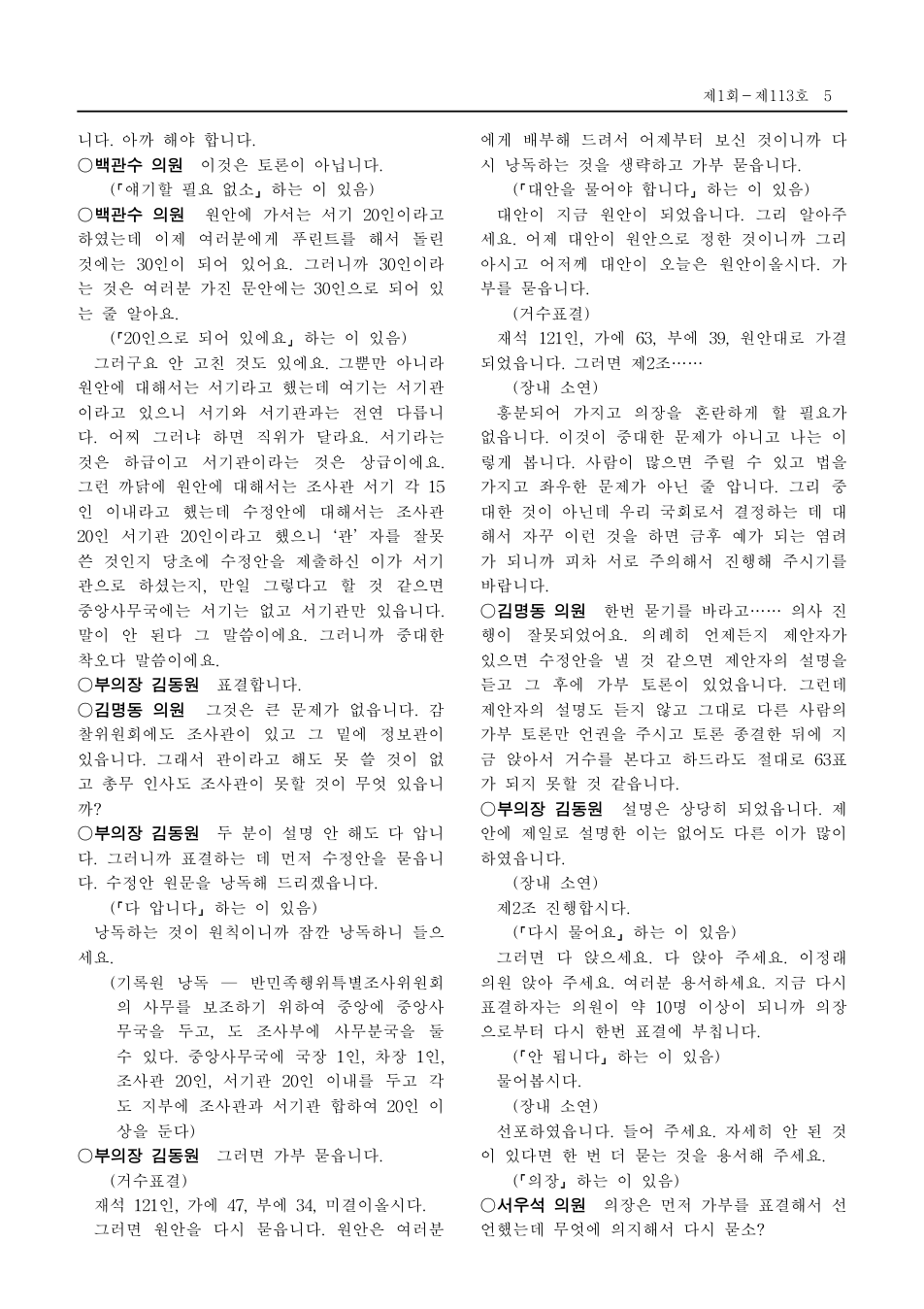
Source page 05 / 14

[Continuation of Representative Kim Myeong-dong's remarks]

I should have spoken earlier.

REPRESENTATIVE BAEK GWAN-SU: This is not debate.

(A voice: “No need to speak!”)

REPRESENTATIVE BAEK GWAN-SU: The original proposal says 20 clerks, but the printed version distributed to members now says 30. You appear to have 30 on the copies in your hands.

(A voice: “It says 20.”)

There are other things that have not been corrected. Furthermore, the original says “clerks” (seogi), whereas this version says “senior clerks” (seogigwan). These are entirely different ranks: a clerk is junior and a senior clerk is of higher rank. The original called for no more than 15 investigators and 15 clerks, while the amendment calls for 20 investigators and 20 senior clerks. Was the suffix “-gwan” written by mistake, or did the sponsors really intend senior clerks? If so, the Central Secretariat would have senior clerks but no ordinary clerks. That makes no sense. This is a serious error.

VICE SPEAKER KIM DONG-WON: We shall vote.

REPRESENTATIVE KIM MYEONG-DONG: That is not a serious problem. The Inspectorate has investigators with intelligence officers under them. There is no reason not to use the rank suffix “-gwan,” and why could investigators not perform general affairs and personnel work?

VICE SPEAKER KIM DONG-WON: Everyone understands without further explanation from you two. We shall vote on the amendment first. I will have the text read aloud.

(A voice: “We already know it.”)

Reading it is the proper procedure. Please listen briefly.

(The recording clerk reads: “To assist the work of the Special Investigation Committee for Anti-National Acts, a Central Secretariat shall be established at the center, and branch secretariats may be established at provincial investigation departments. The Central Secretariat shall have one director, one deputy director, not more than 20 investigators and 20 senior clerks; each provincial branch shall have a combined total of at least 20 investigators and senior clerks.”)

VICE SPEAKER KIM DONG-WON: I put the question to a vote.

(Vote by show of hands.)

Of 121 present, 47 voted for and 34 against; the result is inconclusive. We shall now vote on the original proposal. It has been distributed and members have had it since yesterday, so I shall omit reading it again.

(A voice: “Vote on the alternative!”)

Yesterday's alternative has become today's original proposal. Please understand that. We shall vote.

(Vote by show of hands.)

Of 121 present, 63 voted for and 39 against. The original proposal is adopted. Now, Article 2—

(Commotion in the chamber.)

There is no need to become agitated and disrupt the chair. I do not see this as a fundamental matter: if the staff is too large it can be reduced, and the numbers need not be fixed by statute. But repeated disputes over an Assembly decision may establish an undesirable precedent. Let us all take care in conducting proceedings.

REPRESENTATIVE KIM MYEONG-DONG: I ask that it be put again. The procedure was improper. Whenever a member offers an amendment, the proposer normally explains it before debate on its merits. Here, the proposer was never heard, the floor was given only to others speaking for and against, and debate was closed. Even looking at the hands from here, I do not believe there were 63 affirmative votes.

VICE SPEAKER KIM DONG-WON: The proposal has been adequately explained by others, even though its original sponsor did not speak.

(Commotion.)

Let us proceed to Article 2.

(A voice: “Vote again!”)

Please sit down, all of you. Representative Yi Jeong-rae, please sit. I ask your indulgence: since more than ten members have requested another vote, I shall put the question again.

(A voice: “No!”)

Let us take the vote.

(Commotion.)

The result was announced, but if the count was not clear, please forgive another vote.

(A voice: “Mr. Speaker!”)

REPRESENTATIVE SEO U-SEOK: On what authority does the chair call for another vote after the result has already been announced?

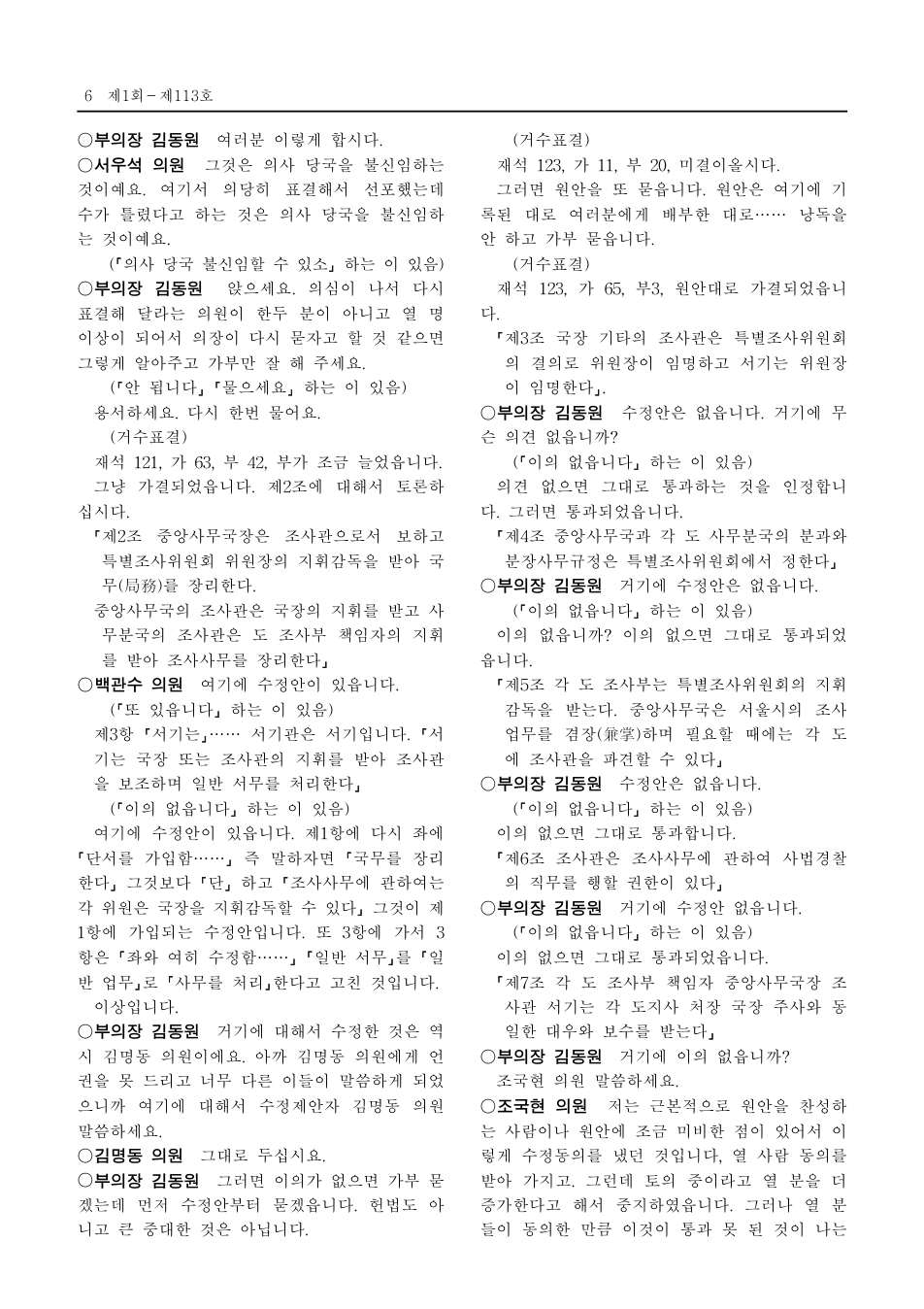
Source page 06 / 14

VICE SPEAKER KIM DONG-WON: Members, let us do it this way.

REPRESENTATIVE SEO U-SEOK: That would amount to a vote of no confidence in those conducting the proceedings. The vote was properly taken and the result announced. To say the count was wrong amounts to discrediting the presiding officers.

(A voice: “They can be subjected to a vote of no confidence!”)

VICE SPEAKER KIM DONG-WON: Please sit. It is not one or two but more than ten members who doubt the count and request another vote. Please understand the chair's decision to put the question once more and cast your votes clearly.

(Voices: “No!” “Take the vote!”)

Please forgive me. I shall put it once more.

(Vote by show of hands.)

Of 121 members present, 63 voted for and 42 against. The number opposed has increased slightly. It is adopted. Let us debate Article 2.

“Article 2. The Director of the Central Secretariat shall be appointed from among the investigators and, under the direction and supervision of the Chair of the Special Investigation Committee, shall administer the affairs of the Secretariat. The investigators of the Central Secretariat shall act under the direction of its director; the investigators of branch secretariats shall act under the direction of the heads of the provincial investigation departments and shall administer investigation work.”

REPRESENTATIVE BAEK GWAN-SU: There is an amendment here.

(A voice: “Another one!”)

A third paragraph reads: “Clerks”—senior clerks are clerks—“shall, under the direction of the director or an investigator, assist investigators and handle general clerical affairs.”

(Voices: “No objection!”)

The amendment to paragraph 1 would add a proviso after “shall administer the affairs of the Secretariat”: “Provided that, in matters concerning investigations, each committee member may direct and supervise the director.” In paragraph 3, it would replace “general clerical affairs” with “general business” and amend the phrase concerning the handling of those duties. That is all.

VICE SPEAKER KIM DONG-WON: These amendments were also proposed by Representative Kim Myeong-dong. We did not give him the floor earlier because others spoke so much. I invite the proposer to explain this amendment now.

REPRESENTATIVE KIM MYEONG-DONG: Leave it as it is.

VICE SPEAKER KIM DONG-WON: If there are no objections, we shall vote, taking the amendment first. This is not the Constitution; it is not such a momentous matter.

(Vote by show of hands.)

Of 123 present, 11 voted for and 20 against; the result is inconclusive. We shall vote on the original text as printed and distributed, without another reading.

(Vote by show of hands.)

Of 123 present, 65 voted for and three against. The original text is adopted.

“Article 3. The director and other investigators shall be appointed by the Chair with the approval of the Special Investigation Committee; clerks shall be appointed by the Chair.”

VICE SPEAKER KIM DONG-WON: There is no amendment. Any comments? (Voices: “No objections!”) In the absence of objections, Article 3 is adopted.

“Article 4. The Special Investigation Committee shall determine the internal divisions and allocation of duties of the Central Secretariat and provincial branch secretariats.”

VICE SPEAKER KIM DONG-WON: There is no amendment. (Voices: “No objections!”) If there are none, it is adopted.

“Article 5. Provincial investigation departments shall be subject to the direction and supervision of the Special Investigation Committee. The Central Secretariat shall also undertake investigation work in Seoul and, when necessary, may dispatch investigators to the provinces.”

VICE SPEAKER KIM DONG-WON: There is no amendment. (Voices: “No objections!”) It is adopted.

“Article 6. Investigators shall be authorized to perform the functions of judicial police officers in relation to investigation work.”

VICE SPEAKER KIM DONG-WON: No amendment? (Voices: “No objections!”) It is adopted.

“Article 7. The heads of provincial investigation departments, the Central Secretariat director, investigators, and clerks shall receive the same treatment and remuneration as provincial governors, department heads, bureau directors, and junior administrative officers, respectively.”

VICE SPEAKER KIM DONG-WON: Any objection? Representative Jo Guk-hyeon, you have the floor.

REPRESENTATIVE JO GUK-HYEON: Fundamentally, I support the original proposal, but I submitted an amendment because I found it deficient in certain respects. I obtained ten supporters, then stopped gathering further signatures because debate had begun. I regret that, despite those ten members' support, the amendment was not adopted.

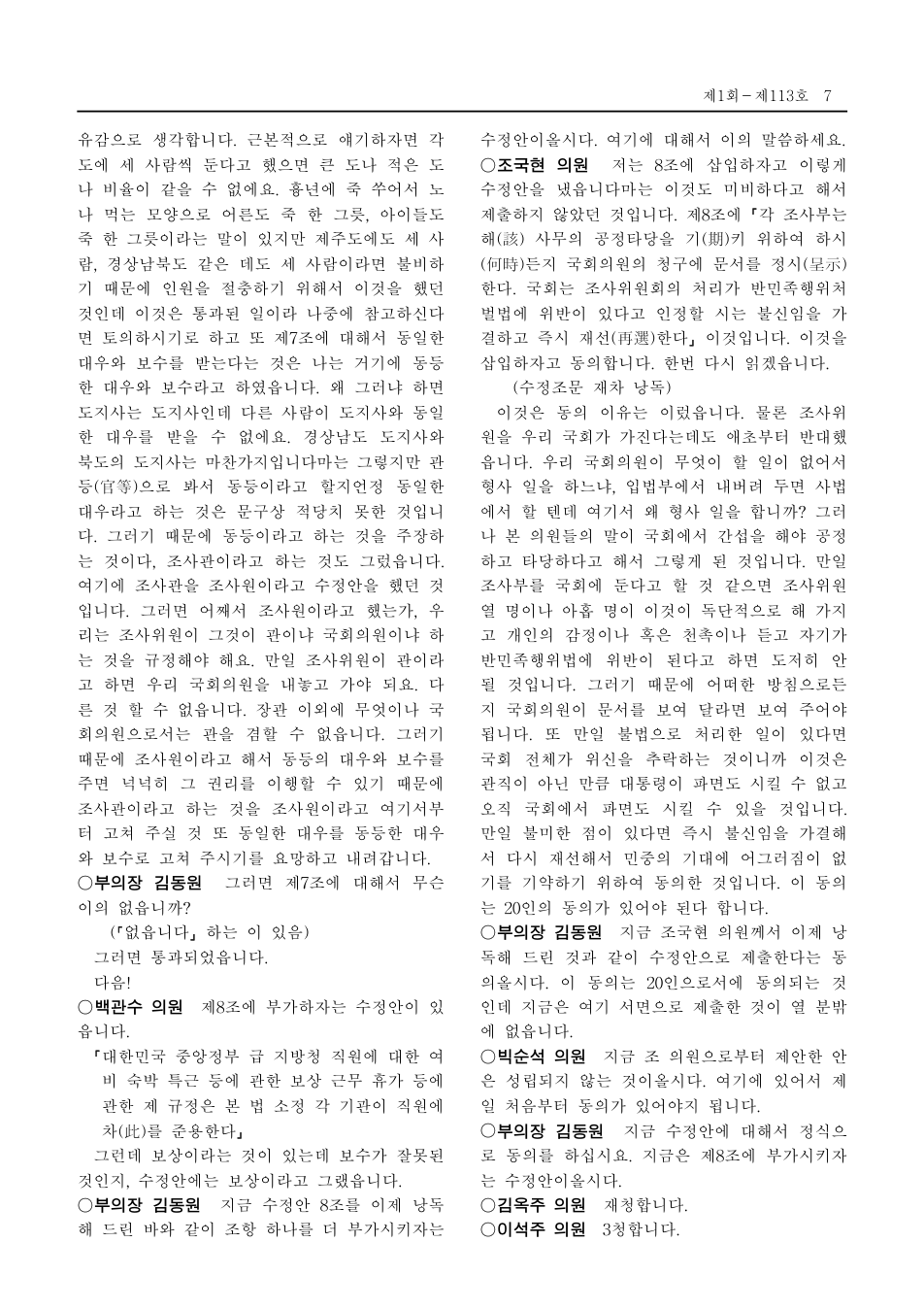
Source page 07 / 14

[Continuation of Representative Jo Guk-hyeon's remarks]

Giving three personnel to every province, large or small, is not an equitable allocation. It is like sharing porridge during a famine and giving the same bowl to a grown person and a child. Three for Jeju and three for North or South Gyeongsang would plainly be inadequate in the latter cases. That is why I proposed adjusting the numbers. But that question has now been settled, and I leave it for future consideration.

Regarding Article 7, I proposed “equivalent treatment and remuneration” rather than “identical treatment and remuneration.” A provincial governor is a provincial governor; another official cannot literally receive identical treatment. The governors of South and North Gyeongsang may be equivalent in official grade, but “identical” is not the appropriate term. That is why I favor “equivalent.” I also proposed changing “investigator” (josagwan, literally investigation officer) to “investigating member” (josawon). We need to determine whether an investigation committee member holds an official post or retains the status of a National Assembly member. If the committee member is an officeholder, he would have to relinquish his Assembly seat, since members cannot concurrently hold most other government offices, apart from ministerial office. Designating the staff as investigating members and giving them equivalent status and remuneration should enable them to exercise their authority. I therefore ask that “investigator” be changed to “investigating member” and “identical treatment” to “equivalent treatment and remuneration.”

VICE SPEAKER KIM DONG-WON: Are there any objections to Article 7? (Voices: “None.”) It is adopted. Next.

REPRESENTATIVE BAEK GWAN-SU: There is an amendment proposing an additional Article 8: “The provisions applying to employees of the central Government and local offices of the Republic of Korea concerning travel expenses, lodging, special-duty compensation, work, leave, and related matters shall apply mutatis mutandis to employees of the agencies provided for in this Act.” The text says “compensation” (bosang); perhaps “remuneration” (bosu) was intended.

VICE SPEAKER KIM DONG-WON: As read, an amendment proposes to insert one further article, Article 8. Please comment.

REPRESENTATIVE JO GUK-HYEON: I also proposed an Article 8, though I initially withheld it because I considered it incomplete. It reads: “To ensure the fairness and propriety of their work, investigation departments shall present documents whenever requested by a member of the National Assembly. If the National Assembly determines that the Investigation Committee's handling of a matter violates the Act on the Punishment of Anti-National Acts, it shall adopt a resolution of no confidence and immediately elect a replacement [committee].” I move that this be inserted.

(The amendment is read a second time.)

My reasons are these. I originally opposed placing the investigation committee within the National Assembly. Why should members of the legislature perform criminal investigations instead of leaving them to the judiciary? But the argument was made that Assembly involvement was necessary to ensure fairness and propriety. If the investigation departments are to be placed under the Assembly, we cannot let nine or ten committee members act arbitrarily on personal feelings or hearsay and declare people in breach of the anti-national-acts law. Assembly members must be allowed to inspect documents on request. If the committee has acted unlawfully, the dignity of the whole Assembly suffers. Since this is not an office from which the President can dismiss members, only the Assembly can remove them. If misconduct occurs, it should immediately pass a no-confidence resolution and elect new members, to meet public expectations. I offer this motion for that purpose. I am told it requires twenty supporters.

VICE SPEAKER KIM DONG-WON: Representative Jo proposes this amendment as just read. Twenty supporters are required, but only ten names have been submitted in writing.

REPRESENTATIVE BIK SUN-SEOK [as printed]: Representative Jo's proposal has not yet been duly constituted as a motion. It must be supported from the outset.

VICE SPEAKER KIM DONG-WON: Please formally second the amendment. The question is whether to add an Article 8.

REPRESENTATIVE KIM OK-JU: I second it.

REPRESENTATIVE YI SEOK-JU: I support it as a third seconder.

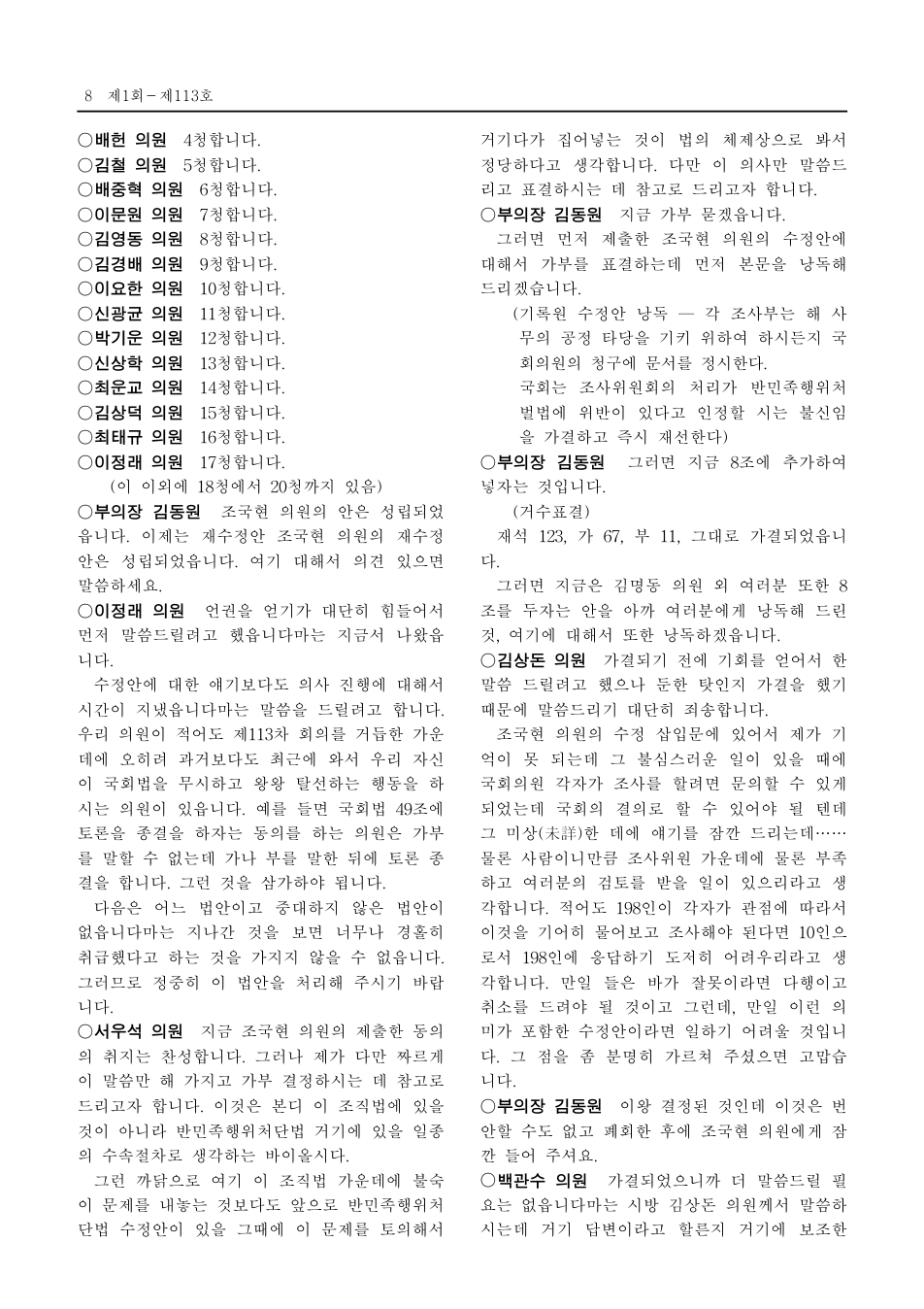
Source page 08 / 14

REPRESENTATIVE BAE HEON: I am the fourth seconder.

REPRESENTATIVE KIM CHEOL: Fifth.

REPRESENTATIVE BAE JUNG-HYEOK: Sixth.

REPRESENTATIVE YI MUN-WON: Seventh.

REPRESENTATIVE KIM YEONG-DONG: Eighth.

REPRESENTATIVE KIM GYEONG-BAE: Ninth.

REPRESENTATIVE YI YO-HAN: Tenth.

REPRESENTATIVE SIN GWANG-GYUN: Eleventh.

REPRESENTATIVE PARK GI-UN: Twelfth.

REPRESENTATIVE SIN SANG-HAK: Thirteenth.

REPRESENTATIVE CHOE UN-GYO: Fourteenth.

REPRESENTATIVE KIM SANG-DEOK: Fifteenth.

REPRESENTATIVE CHOE TAE-GYU: Sixteenth.

REPRESENTATIVE YI JEONG-RAE: Seventeenth.

(Three further supporters, eighteenth through twentieth, are recorded without names.)

VICE SPEAKER KIM DONG-WON: Representative Jo Guk-hyeon's amendment is now duly moved. His further amendment is before us. Those wishing to comment may speak.

REPRESENTATIVE YI JEONG-RAE: It has been very difficult to obtain the floor. I wanted to speak earlier but have only now been recognized. Rather than the substance of the amendment, I wish to discuss our procedure. After 113 sittings, some members seem lately more inclined than before to disregard the Assembly Rules and depart from procedure. For example, Article 49 of those Rules forbids a member moving closure of debate from first arguing for or against the question. Yet members have argued one side and then moved closure. We should refrain from this. Every bill is important, but I cannot help feeling that past bills have sometimes been treated too lightly. I urge that this one be handled with due seriousness.

REPRESENTATIVE SEO U-SEOK: I support the purpose of Representative Jo's motion, but ask members to consider a brief point before voting. The provision concerns procedure and properly belongs, I believe, in the Act on the Punishment of Anti-National Acts rather than this organizational statute. It would be legally more appropriate to discuss and insert it when that substantive Act is amended, rather than abruptly introducing it here. I offer this observation for your consideration.

VICE SPEAKER KIM DONG-WON: We shall now vote on Representative Jo Guk-hyeon's amendment. The wording will first be read.

(The recording clerk reads: “To ensure fairness and propriety in their work, investigation departments shall present documents whenever requested by a National Assembly member. If the Assembly determines that the Investigation Committee's handling of a matter violates the Act on the Punishment of Anti-National Acts, it shall adopt a vote of no confidence and immediately elect replacements.”)

VICE SPEAKER KIM DONG-WON: The proposal is to insert this as Article 8.

(Vote by show of hands.)

Of 123 present, 67 voted for and 11 against. The amendment is adopted. We now turn to the other proposal for an additional Article 8, sponsored by Representative Kim Myeong-dong and others, which was read earlier. It will be read again.

REPRESENTATIVE KIM SANG-DON: I had intended to speak before it was adopted, but, perhaps because I was too slow, I was unable to do so; I apologize for speaking now. I do not recall the exact terms of Representative Jo's provision. If it allows each individual Assembly member to inspect investigation papers whenever that member considers something suspect, surely this should require a resolution of the Assembly. The committee members may be imperfect and should be subject to examination; but if all 198 Assembly members can demand answers according to their own views, a committee of ten cannot possibly respond to 198 persons. If I have misunderstood, I gladly withdraw my concern; if the amendment has that meaning, however, it will make the committee's work very difficult. I would appreciate clarification.

VICE SPEAKER KIM DONG-WON: The matter has already been decided and cannot now be reconsidered. Please speak briefly to Representative Jo after the adjournment.

REPRESENTATIVE BAEK GWAN-SU: Though the amendment has passed, I wish to add something by way of reply to Representative Kim Sang-don.

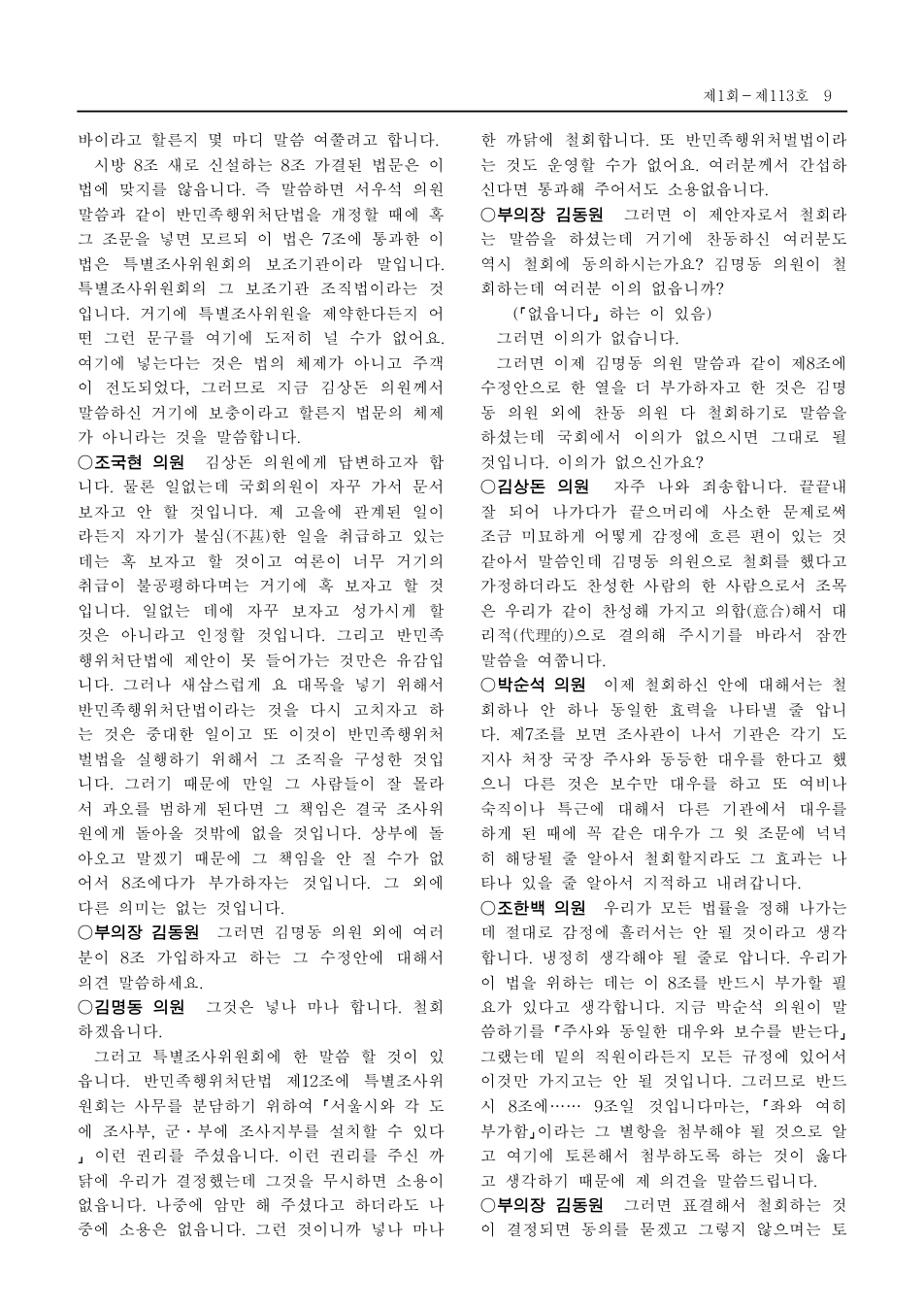
Source page 09 / 14

[Continuation of Representative Baek Gwan-su's remarks]

The new Article 8 just adopted is not suited to this statute. As Representative Seo U-seok observed, the provision might belong in an amendment to the Act on the Punishment of Anti-National Acts, but the law before us concerns the auxiliary organs of the Special Investigation Committee; its seven articles constitute an organizational statute. A restriction on the committee's own members cannot properly be put into a law organizing its auxiliary agencies. That would reverse the relationship between principal and subordinate. I offer this explanation in support of Representative Kim Sang-don's point: it is not a provision consistent with the structure of this law.

REPRESENTATIVE JO GUK-HYEON: I would like to answer Representative Kim Sang-don. Assembly members are not going to request documents pointlessly. A member might request them in connection with his own constituency, or where something seems improper, or where public opinion alleges serious unfairness. Members will not make needless requests merely to inconvenience the committee. I regret that the proposal cannot be put into the substantive Anti-National Acts law; but reopening that law solely to insert this clause would itself be a serious matter. This organizational statute is being enacted to implement the Act on the Punishment of Anti-National Acts. If investigators make mistakes through ignorance, the responsibility ultimately falls on the Investigation Committee. As the committee will have to bear that responsibility, I proposed Article 8. There is no other intention.

VICE SPEAKER KIM DONG-WON: We now invite comments on the other proposed addition of an Article 8, sponsored by Representative Kim Myeong-dong and colleagues.

REPRESENTATIVE KIM MYEONG-DONG: It makes no difference whether it is included. I withdraw it. I also wish to say something to the Special Investigation Committee. Article 12 of the Act on the Punishment of Anti-National Acts empowers the Committee, for the allocation of its work, to establish investigation departments in Seoul and the provinces and investigation branches in counties and municipalities. We decided to confer those powers. If they are disregarded, that decision is meaningless, no matter what assistance members promise later. That is why including the provision makes little difference, and I withdraw it. Nor can the Anti-National Acts law be administered effectively if you continually interfere with the Committee. There would be no point passing the law under such conditions.

VICE SPEAKER KIM DONG-WON: The proposer says he wishes to withdraw the amendment. Do its other supporters agree? Are there objections to Representative Kim's withdrawal?

(Voices: “None.”)

Then there are no objections. Representative Kim and his supporters have said that they will withdraw their proposed additional Article 8, if the Assembly has no objection. Are there objections?

REPRESENTATIVE KIM SANG-DON: Forgive me for repeatedly taking the floor. Matters were proceeding well until this small question arose at the end, and feelings appear to have entered into it. Although Representative Kim has proposed withdrawal, as one of those who supported the provision I ask that we reach a common understanding and adopt a considered decision on it.

REPRESENTATIVE PARK SUN-SEOK: I believe withdrawing the amendment would have the same practical effect as retaining it. Article 7 already gives investigators and other officers treatment and remuneration equivalent to that of the corresponding provincial and government officials. Travel allowances, overnight duty, special service, and similar benefits should naturally be covered by the same treatment. I point this out before sitting down.

REPRESENTATIVE JO HAN-BAEK: When making laws we must not be swayed by emotions. We must think dispassionately. I believe it is necessary to add this article. Representative Park has noted that the officers “shall receive the same treatment and remuneration as junior administrative officers,” but that alone does not cover subordinate employees or all the detailed regulations. Therefore we should attach the additional clause—perhaps it would now be Article 9—setting out the applicable provisions. I ask that it be debated and inserted.

VICE SPEAKER KIM DONG-WON: We shall vote on whether to permit withdrawal. If withdrawal is approved, I shall put the other motion; otherwise we shall debate it.

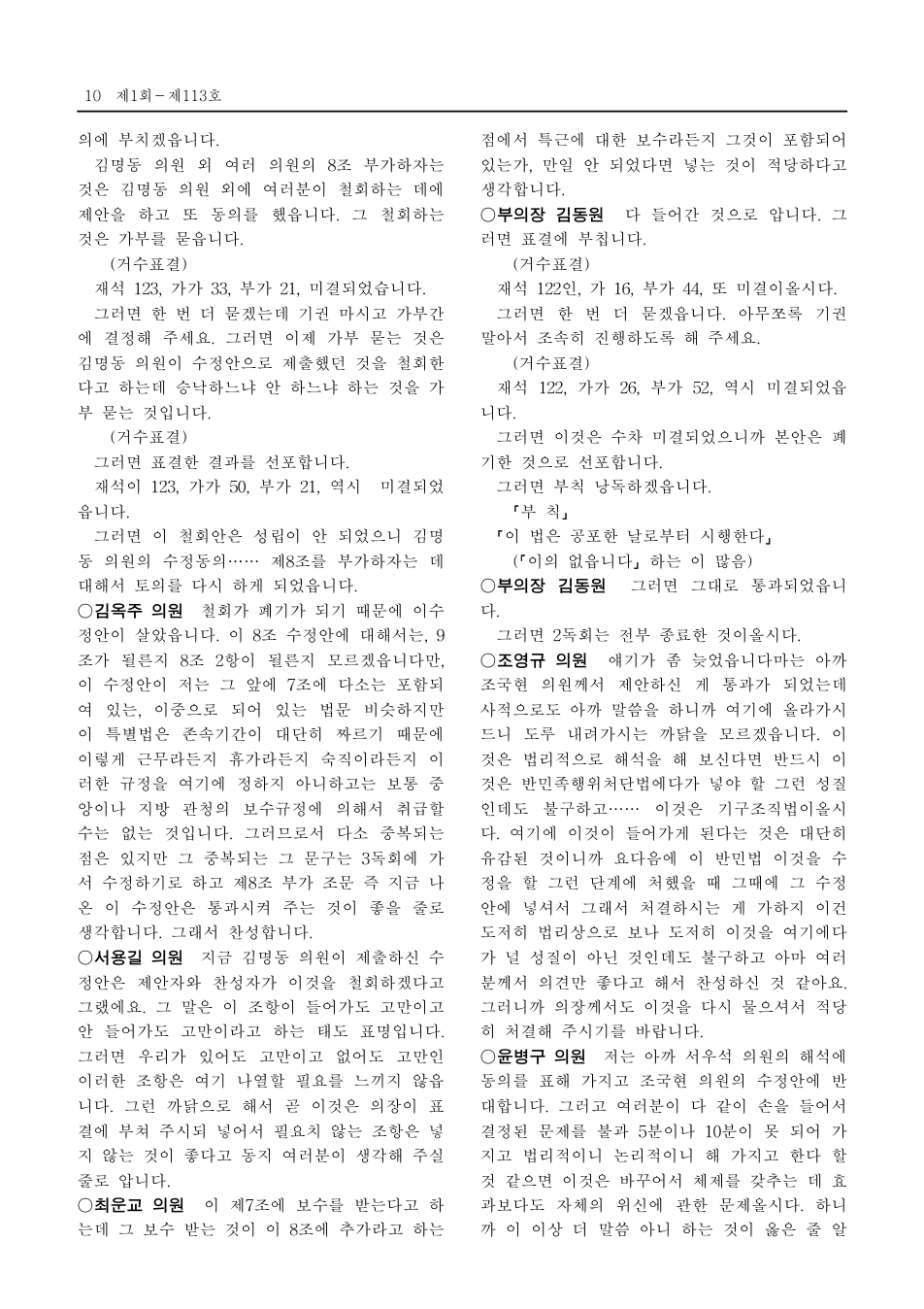
Source page 10 / 14

[Continuation of the Vice Speaker's remarks]

Representative Kim Myeong-dong and other members have proposed withdrawing their amendment to add Article 8. I put permission to withdraw it to a vote.

(Vote by show of hands.)

Of 123 members present, 33 voted for and 21 against. The result is inconclusive. We shall vote again. Please do not abstain; cast a vote for or against so that we can reach a decision. The question is whether the Assembly permits the withdrawal of the amendment submitted by Representative Kim Myeong-dong.

(Vote by show of hands.)

I announce the result: of 123 members present, 50 voted for and 21 against. It remains inconclusive. Because permission to withdraw has not been granted, Representative Kim's motion to add Article 8 remains before us for debate.

REPRESENTATIVE KIM OK-JU: Since the motion to withdraw has failed, the amendment remains alive. Whether it becomes Article 9 or paragraph 2 of Article 8, the proposed provision is somewhat duplicative of Article 7. Yet this is a special law with a very short lifespan. Unless we set out rules on work, leave, overnight duty, and other conditions, the normal remuneration regulations of central and local offices cannot automatically govern the special agencies. Although some wording overlaps, it can be adjusted at the third reading. I support adopting this new provision.

REPRESENTATIVE SEO YONG-GIL: Representative Kim Myeong-dong and the other sponsors have said they wish to withdraw their amendment. That shows they regard the clause as dispensable, whether included or not. A clause considered unnecessary by its own sponsors has no place in the statute. I therefore ask that it be voted upon and that members reject unnecessary provisions.

REPRESENTATIVE CHOE UN-GYO: Article 7 provides for remuneration. Does that include the special-duty pay and related allowances addressed in the proposed Article 8? If not, adding it would be appropriate.

VICE SPEAKER KIM DONG-WON: I understand that those matters are already included. We shall vote.

(Vote by show of hands.)

Of 122 present, 16 voted for and 44 against; the result is again inconclusive. We shall vote again. Please refrain from abstaining so that the matter may be disposed of promptly.

(Vote by show of hands.)

Of 122 present, 26 voted for and 52 against; the result is still inconclusive. Since the matter has remained undecided after repeated votes, I declare the proposal rejected. The supplementary provision will now be read.

“SUPPLEMENTARY PROVISION: This Act shall enter into force on the date of its promulgation.”

(Many voices: “No objections!”)

VICE SPEAKER KIM DONG-WON: It is adopted as read. This concludes the second reading in its entirety.

REPRESENTATIVE JO YEONG-GYU: Forgive me for speaking so late, but the provision proposed by Representative Jo Guk-hyeon was adopted earlier. I do not understand why, when we discussed it privately, he came forward and then stepped back. As a matter of legal interpretation, it certainly belongs in the Act on the Punishment of Anti-National Acts, not in this organizational statute. I regret that it has been inserted here. It should be considered instead when the substantive law is amended. I suspect members agreed with its purpose without considering whether it belongs in this law. I ask the chair to put the matter again and deal with it appropriately.

REPRESENTATIVE YUN BYEONG-GU: I agree with Representative Seo U-seok's interpretation and oppose Representative Jo Guk-hyeon's amendment. Nevertheless, after the Assembly has voted by show of hands, reopening its decision only five or ten minutes later on grounds of legal form or logic would damage the dignity of the Assembly more than it would improve the structure of the statute. I believe we should say no more on the matter.

Source page 11 / 14

[Continuation of Representative Yun Byeong-gu's remarks]

I oppose Representative Jo's proposal. I also move that the second reading now conclude and the matter proceed to the Legislation and Judiciary Committee for the third reading.

REPRESENTATIVE GWON TAE-HUI: I second the motion.

REPRESENTATIVE SIN SANG-HAK: I support it as a third seconder.

REPRESENTATIVE SEO U-SEOK: Mr. Speaker, some wording in the articles is unsuitable. It is incorrect to say that the third reading will be sent to the Legislation and Judiciary Committee. The third reading should be dispensed with in the plenary sitting, while only the wording is referred to that committee for revision.

REPRESENTATIVE YUN BYEONG-GU: That statement is mistaken.

VICE SPEAKER KIM DONG-WON: Are there objections? (Vote by show of hands.) Of 121 members present, 71 voted for and none against. The motion is adopted. We should now continue with the Bill on the Organization of Attached Agencies of the Special Tribunal for Anti-National Acts.

(Voices: “Agreed.”)

We shall proceed. I ask the committee chair to come forward and give an explanation of the bill in general terms.

2. FIRST READING: BILL ON THE ORGANIZATION OF ATTACHED AGENCIES OF THE SPECIAL TRIBUNAL FOR ANTI-NATIONAL ACTS

REPRESENTATIVE KIM SANG-DEOK: I explained yesterday how this bill concerning the Special Tribunal's organization came to be drafted. I have nothing further to add today and will therefore read the articles directly.

ACT ON THE ORGANIZATION OF ATTACHED AGENCIES OF THE SPECIAL TRIBUNAL FOR ANTI-NATIONAL ACTS

Article 1. A Special Secretariat shall be established as an attached agency of each of the Special Tribunal for Anti-National Acts and the Special Prosecution Department.

Article 2. Each Secretariat shall have a director. The director shall receive the same treatment and remuneration as the director of the Secretariat of the Supreme Court or of the Supreme Prosecutors' Office. Under the orders of the presiding judge of the Special Tribunal or the Chief Special Prosecutor, the director shall administer the affairs of the respective department.

Article 3. The Secretariat of the Special Tribunal shall have not more than 16 senior clerks, and the Special Prosecution Department shall have not more than nine senior clerks. Senior clerks shall have the same treatment and remuneration, duties, and powers as senior clerks of the Supreme Court or Supreme Prosecutors' Office.

Article 4. The presiding judge of the Special Tribunal shall appoint and dismiss the director and senior clerks belonging to its Secretariat. The Chief Special Prosecutor shall appoint and dismiss the director and senior clerks belonging to the Special Prosecution Department.

Article 5. This Act shall enter into force on the date of promulgation.

REPRESENTATIVE BAE JUNG-HYEOK: I move that questions and general debate be omitted and that we proceed directly to the next reading.

REPRESENTATIVE KIM CHEOL: I second it.

REPRESENTATIVE SIN SANG-HAK: I support it as a third seconder.

VICE SPEAKER KIM DONG-WON: The motion is to dispense with the first reading and proceed to the second reading and discussion. (Vote by show of hands.) Of 122 members present, 78 voted for and none against. The motion is carried. The chair will now read the bill article by article.

(Representative Kim Sang-deok reads the Special Tribunal Attached Agencies Organization Bill article by article.)

“Act on the Organization of Attached Agencies of the Special Tribunal for Anti-National Acts.”

VICE SPEAKER KIM DONG-WON: Any objections? (Voices: “None.”) The title is approved.

“Article 1. A Special Secretariat shall be established as an attached agency of each of the Special Tribunal for Anti-National Acts and the Special Prosecution Department.”

VICE SPEAKER KIM DONG-WON: Any objections? (Voices: “None.”) Article 1 is approved.

“Article 2. Each Secretariat shall have a director. The director shall receive the same treatment and remuneration as the director of the Secretariat of the Supreme Court or of the Supreme Prosecutors' Office. Under the orders of the presiding judge of the Special Tribunal or the Chief Special Prosecutor, the director shall administer the affairs of the respective department.”

VICE SPEAKER KIM DONG-WON: Any objections? (Voices: “None.”) Article 2 is approved.

“Article 3. The Secretariat of the Special Tribunal shall have not more than 16 senior clerks, and the Special Prosecution Department shall have not more than nine senior clerks. These senior clerks shall receive the same treatment and remuneration as, and have the same duties and powers as, senior clerks of the Supreme Court or Supreme Prosecutors' Office.”

REPRESENTATIVE NA YONG-GYUN: Please explain what needs and staffing arrangements led you to set the limits at 16 in the Special Tribunal's Secretariat and nine in the Special Prosecution Department.

REPRESENTATIVE KIM SANG-DON: To give the precise reason, the Special Tribunal is constituted with 16 judges. We thought that at least one clerk should be assigned to each judge. That explains the figure of 16.

Source page 12 / 14

[Continuation of Representative Kim Sang-don's remarks]

The other figure, nine [the record here says “for the Special Tribunal”], was chosen for a similar reason.

(Voices: “No objections!”)

VICE SPEAKER KIM DONG-WON: Article 3 is approved.

“Article 4. The presiding judge of the Special Tribunal shall appoint and dismiss the director and senior clerks of its Secretariat. The Chief Special Prosecutor shall appoint and dismiss the director and senior clerks of the Special Prosecution Department.”

VICE SPEAKER KIM DONG-WON: Any objections? (Voices: “None.”) Article 4 is approved.

“Article 5. This Act shall enter into force on the date of promulgation.”

VICE SPEAKER KIM DONG-WON: Any objections? (Voices: “None.”) Article 5 is approved. What do members think of dispensing with the third reading and passing the bill in this form?

(Voices: “Agreed.”)

There being no objections, the second reading is concluded, the third reading is dispensed with, and that decision is adopted.

(A voice: “Proceed to item five!”)

Shall we take a five-minute break? (Voices: “Agreed.”) We shall recess for five minutes.

(Sitting suspended at 12:30 p.m.)

(Sitting resumed at 12:35 p.m.)

VICE SPEAKER KIM DONG-WON: We now take up the amendment to the Act on the Punishment of Anti-National Acts. As previously reported, the Legislation and Judiciary Committee examined it. As stated yesterday, however, the Assembly decided to place it on the agenda within the same session. The proposals concern adding a second paragraph to Article 15 and a proviso to Article 26, paragraph 1, and deleting certain wording from Article 26, paragraph 2. Representative Kim Sang-deok will briefly explain them before debate.

3. FIRST READING: BILL AMENDING THE ACT ON THE PUNISHMENT OF ANTI-NATIONAL ACTS

REPRESENTATIVE KIM SANG-DEOK: I explained yesterday why it was necessary to amend the Anti-National Acts Punishment Act. I thank members for agreeing to place the bill on the agenda for debate. From the Special Investigation Committee's point of view, certain additions are needed if we are actually to carry out the work. The organizational laws for the special investigation agencies and the attached agencies of the Special Tribunal have now been passed. To fulfill the purpose of the substantive Act on the basis of those two laws, we believe that certain provisions must be amended.

First, a provision must be inserted into Article 15 of Chapter II if we are to perform our duties effectively: “When necessary for an investigation, a special investigation committee member may direct and command judicial police officials.” We believe this authority is essential for the proper execution of our duties.

Second, a proviso should be added to Article 26, paragraph 1: “Provided that, where the decision of a Special Prosecutor is deemed inappropriate, the Special Investigation Committee may request reconsideration by agreement of all the Special Prosecutors.” This addresses what happens when the Committee has investigated a person covered by the Act and has sent the investigation papers to the Special Prosecution Department, but the prosecutor declines to indict. Because there is only a single level of proceedings, rather than first, second, and third instances, the question of refusing to prosecute after a thorough investigation is particularly important. We therefore proposed that all nine special prosecutors consider whether a decision not to prosecute is appropriate, instead of allowing the chief prosecutor alone to decide, so as to establish a means of resolving disagreements.

Finally, we consider that the Special Investigation Committee and the special judicial bodies should stand on equal footing, rather than the Special Prosecution Department exercising command over the Committee. We therefore seek to delete the eight Korean characters meaning “special investigation committee member or” from Article 26, paragraph 2. I ask members to support adding the proposed paragraph to Article 15, adding the proviso to Article 26, paragraph 1, and deleting that phrase from Article 26.

Source page 13 / 14

[Continuation of Representative Kim Sang-deok's remarks]

I would be grateful if you would examine the amendment carefully and adopt the version requested by the Special Investigation Committee.

VICE SPEAKER KIM DONG-WON: As just explained, the Committee proposes inserting into Article 15, as paragraph 2, the provision: “A special investigation committee member may, when necessary, direct and command judicial police officials.” Please speak on this proposal first.

(Voices: “No objections!”)

VICE SPEAKER KIM DONG-WON: As it was referred to the Legislation and Judiciary Committee and a revised version was prepared, I shall first invite that committee's chair to give the Assembly its views before debate.

REPRESENTATIVE BAEK GWAN-SU: As I previously reported as chair of the Legislation and Judiciary Committee, we considered the amendment to the Act on the Punishment of Anti-National Acts. As explained yesterday and the day before, it has nevertheless been placed on the agenda for discussion within this session. I shall report the results of our committee's examination.

Chair Kim Sang-deok of the Special Investigation Committee has described three requested changes: insertion of a second paragraph into Article 15; insertion of a proviso into Article 26; and alteration of Article 26, paragraph 2. Regarding Article 15, paragraph 2, he sought wording that, as quoted in this part of the printed record, says: “When required for an investigation, a special investigation committee member may direct and command judicial prosecutorial officers.” The Legislation and Judiciary Committee also supports the purpose of this clause.

Regarding Article 26, paragraph 1, the Special Investigation Committee proposed: “Provided that, if a Special Prosecutor's decision is deemed improper, the Special Investigation Committee may request reconsideration by agreement of all the Special Prosecutors.” We agree that a proviso is needed, but we consider reconsideration by unanimous agreement of the prosecutors legally inappropriate. Our revision therefore reads: “Provided that, where the decision of a Special Prosecutor is deemed inappropriate, the Special Investigation Committee may request reconsideration by the Chief Special Prosecutor.” The original amendment called for agreement of all prosecutors, but, as members know, prosecutors do not act as a collective deliberative body in that legal sense, even if they may consult one another in practice. In an individual case, the prosecutor responsible investigates and gathers evidence and, if prosecution is warranted, submits a recommendation through the deputy chief and obtains authorization from the chief prosecutor before filing charges. A request for reconsideration should therefore be directed to the chief prosecutor, not to all nine special prosecutors acting by consensus. Even with nine prosecutors, one handles the case and proceeds through the chain of authorization. Unanimous reconsideration would be inconsistent with the legal character of the prosecutorial office. Our revision follows the purpose of the proposal while allowing the Special Investigation Committee to ask the Chief Special Prosecutor to reconsider.

As for Article 26, paragraph 2, the original wording is: “A Special Prosecutor may, when required for prosecution, direct and command a special investigation committee member or judicial police officer.” The sponsors asked that the words “special investigation committee member or” be deleted, because committee members should not be subordinated to the commands of a Special Prosecutor. The Special Investigation Committee is a distinct institution, and the structure should not permit such commands. Our committee agrees with the objective, but proposes the expression “commission a special investigation committee member to conduct a further investigation, or ...” The Committee would investigate a case and transmit its papers to the prosecution; if the prosecutor considers the investigation incomplete or finds prosecution difficult, he should be able to request further investigation rather than issue an order to the Committee.

Source page 14 / 14

[Continuation of Representative Baek Gwan-su's remarks]

Thus, a prosecutor may directly command judicial police officials, but should not issue direct commands to the Special Investigation Committee. Instead, he may commission its members to reinvestigate the case. We considered that this wording would be appropriate.

VICE SPEAKER KIM DONG-WON: Since this is an amendment to a law, it must formally undergo first, second, and third readings. Please bear that in mind. The committee chairs have explained the proposals concerning Articles 15 and 26. Members may now ask questions, as is customary at the start of the first reading, or move to dispense with questions. Please state your wishes.

REPRESENTATIVE KIM OK-JU: The time is up. Let us meet tomorrow.

REPRESENTATIVE JANG BYEONG-MAN: I have a question for everyone. Under our National Assembly Rules, within the same session—

(A voice: “That has already been decided!”)

It may have been decided, but please hear me out. There was a question whether legislation could be amended again in the same session. In the present case, deleting words from Article 26, paragraph 2, certainly seems impermissible under the principle that a matter once decided may not be reconsidered in the same session. Apart from deletion, I also want to know why the committee's reviewed text differs from the sponsors' amendment when, as I understand them, they have the same meaning. Please explain clearly.

REPRESENTATIVE KIM BYEONG-HOE: The Legislation and Judiciary Committee has now produced what it calls a reviewed version of the amendment to the Act on the Punishment of Anti-National Acts, which Chair Baek Gwan-su has just explained. I believe the committee has no authority to present such a reviewed version. The amendment was originally referred to the committee for examination and a report. But because the committee took the position that the Act could not be amended within the same session, it did not place the bill before the plenary. Yesterday, relying on the proviso to Article 33, paragraph 4, of the National Assembly Rules, more than thirty members requested that it be brought back for debate in this chamber. That being the case, the committee has no authority now to submit a new reviewed version. It previously presented no substantive text, on the ground that the proposal should not be taken up. Now it produces a reviewed text and gives a lengthy explanation. On what authority? The chair might report what views existed at the time, but I do not believe we need to take up the Legislation and Judiciary Committee's supposed reviewed proposal as a separate matter. I have spoken solely on the rules of the Assembly.

VICE SPEAKER KIM DONG-WON: Let us proceed in this way. I thought there were only two or three points and that we could settle them in twenty or thirty minutes. But the debate has become quite extensive, and time is up. We shall suspend today's proceedings and take up the question tomorrow. The sitting is now adjourned.

(The sitting adjourned at 1:00 p.m.)