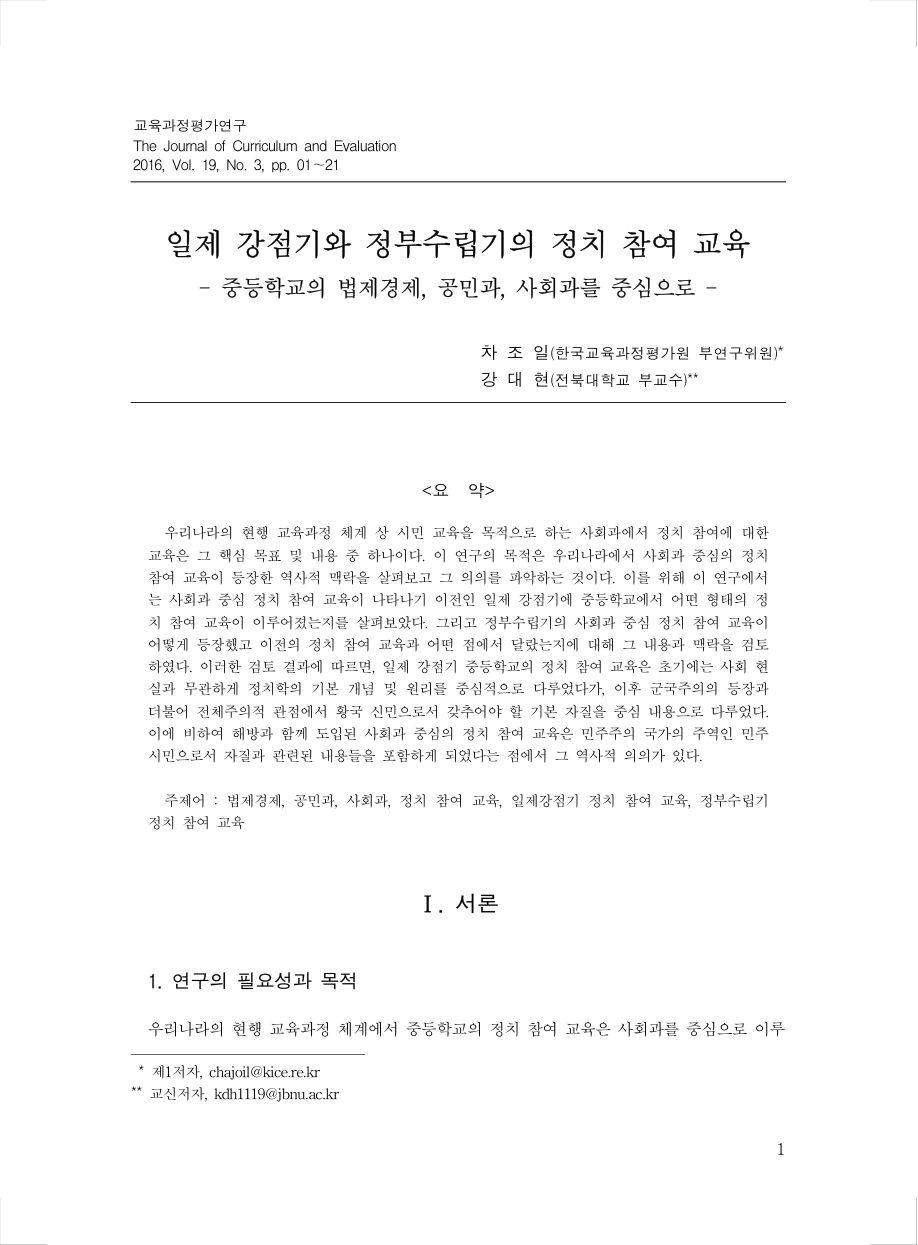
Abstract
Within Korea’s current curriculum framework, education for political participation is one of the central aims and components of social studies, a subject intended to provide citizenship education. This study examines the historical context in which social-studies-based education for political participation emerged in Korea and identifies its significance. It first considers the forms taken by political participation education in secondary schools during Japanese colonial rule, before the emergence of education centred on social studies. It then examines how social-studies-based political participation education appeared during the period of government establishment, and how its content and context differed from earlier forms. The examination shows that, in the early colonial period, secondary-school education in political participation chiefly addressed basic concepts and principles of political science, with little connection to social realities. Later, as militarism emerged, instruction concentrated on the basic qualities required of imperial subjects from a totalitarian perspective. By contrast, the historical significance of the social-studies-based education for political participation introduced upon liberation lies in its inclusion of the qualities of democratic citizens, the principal actors in a democratic state.
Keywords: Laws and Economics (Beopje Gyeongje); Civics (Gongmin-gwa); Social Studies; Education for Political Participation; Political Participation Education under Japanese Colonial Rule; Political Participation Education during the Government-Establishment Period.
I. Introduction
1. Research Rationale and Purpose
Under Korea’s current curriculum, education for political participation at the secondary-school level is conducted primarily through social studies. Since social studies seeks not only an understanding of social phenomena but also the cultivation of civic qualities, political education within social studies aims both to develop an understanding of the basic concepts and principles of political science and to foster the civic qualities needed to participate in actual political affairs. In this respect, contemporary secondary-school subjects concerned with political education—including middle-school Social Studies and the high-school elective Politics and Law—have struggled to reconcile the two objectives of political-science education, which seeks an understanding of political phenomena, and political-participation education, which concerns involvement in the public activities of the state and government.[1]
To recognize this problem properly, it is necessary to examine why, and in what historical context, social-studies-based education for political participation emerged in Korea. Reflection on historical context generally makes it easier to understand a matter’s significance in its entirety. For that reason, this study systematically reviews the historical circumstances in which social-studies-based political participation education appeared in Korea, with the aim of identifying its historical and social significance.
Social studies was introduced in Korea, and education for political participation centred on social studies emerged, during the period of government establishment. As Korea emerged from Japanese colonial domination after liberation and embarked on constructing an independent democratic state, a form of political participation education different from that of the colonial period appeared. Accordingly, understanding the significance of social-studies-based political participation education in secondary schools after liberation requires comparison with secondary-school political participation education under Japanese colonial rule. Only by examining which subjects carried such instruction during colonial rule, what forms it took, and how it changed with liberation and the construction of a democratic state can the historical significance of the education introduced during government establishment be brought into focus.
This study therefore examines the transformation of secondary-school education for political participation from Japanese colonial rule to the government-establishment period through primary materials—including statutes, syllabuses and textbooks—and places the different emphases of political participation education in each period within their historical contexts.
2. Research Content and Method
To identify the historical significance of the education for political participation that emerged with the introduction of social studies during the period of government establishment, this study addresses the following research questions:
First, what did education for political participation in secondary schools look like under Japanese colonial rule?
Second, how did secondary-school education for political participation centred on social studies during the government-establishment period differ from education in the preceding period?
Third, what was the historical significance of secondary-school education for political participation centred on social studies during the government-establishment period?
To address these three research questions,[2] the study conducts a literature-based investigation centred on primary materials such as education-related statutes, syllabuses and textbooks from the Japanese colonial and government-establishment periods. Such materials were previously difficult to access. More recently, however, the development of digital databases of official gazettes and books has made them more accessible and easier to analyse.
The materials examined concern the secondary-school subjects associated with education for political participation in the colonial and government-establishment periods: Laws and Economics, Civics, and Social Studies. To focus on the forms of instruction most widely practised at the time, the analysis excludes vocational schools, teacher-training schools and various foreign-language schools from the secondary-school institutions considered.
The study investigates the formation of these subjects, the processes through which they were introduced into colonial Korea and the Republic of Korea, the curricular organization and allocation of teaching hours, their character and objectives, and their component content. By comparing these features with political participation education under colonial rule, it seeks to establish the historical significance of the social-studies-based political participation education that emerged during government establishment.
II. Political Participation Education Centred on Laws and Economics under Japanese Colonial Rule
1. The Japanese Subject of Laws and Economics and Political Participation Education
Japan, pursuing modernization through the Meiji Restoration, introduced a modern education system through the promulgation of the Education System Order (Gakusei, 學制) in 1872 and the enactment of the Education Order (Kyōikurei, 敎育令) in 1879. Under the former, subjects associated with political education included General Principles of the Form of Government (政體大意), General Principles of National Conditions (國勢學大意), and Institutions, Laws and Ordinances (制度法令). Under the latter, a subject on the laws and ordinances of Japan (本邦法令) was offered (文部省, 1872; 大森茂作, 1881, pp. 1–10).
At that time, however, institutions for political participation, such as a constitution or a parliament, had not been established, so school education could not directly teach political participation. Indeed, fearing political upheaval as the Freedom and People’s Rights Movement and the movement for the establishment of a national assembly gained strength, the Japanese government abolished even these political-education-related subjects through the School Orders (Gakkōrei, 學校令) of 1886—which replaced the existing Education Order and included the Imperial University Order, Elementary School Order, Middle School Order and Normal School Order (千葉敬止, 1926, pp. 3–4).[3]
Political participation began to appear in Japanese school education when it became institutionalized through the introduction of local institutions with elements of residents’ self-government and parliamentary elections following the adoption of a constitution. The system of local self-government was organized through the introduction of the City System and Town-and-Village System in 1888, followed by the Prefectural System and District System in 1890 (강광수, 2015). Furthermore, despite government repression, the continuing Freedom and People’s Rights Movement contributed to the promulgation of the Imperial Constitution in 1889 and to the opening of the Imperial Diet following the first House of Representatives election in 1890.
With the introduction of constitutional government through the constitution, and the establishment of modern local institutions centred on municipalities and prefectures, Japanese people were guaranteed at least limited political participation as imperial subjects. As participation became institutionalized to some extent, demand for political education in schools also increased. Accordingly, the implementing regulations of the Middle School Order promulgated in 1901 assigned the subject Laws and Economics (法制及経済), which dealt with political participation, three hours per week in the fifth year (静岡県立浜松中学校, 1902, pp. 8–24).[4]
The politically relevant areas or major units of the 1902 syllabus for Laws and Economics were threefold: subjects of the empire, the Imperial Diet, and administration. The first area addressed the rights and duties of imperial subjects and prescribed instruction in eligibility to hold public office (a constitutional entitlement). The Imperial Diet unit covered the organization of parliament and elections to the House of Representatives. The administration unit covered local self-government through prefectural assemblies, prefectural councils, municipal assemblies, municipal councils and related bodies (文部省, 1902, pp. 118–120).[5]
The specific content of political participation education in Laws and Economics can also be identified through an introductory handbook on the teaching of the subject. In the unit on imperial subjects, the right to enter public service (eligibility to hold public office) was presented as the first of the subjects’ rights (持地六三郎, 1903, p. 27). The Imperial Diet unit explained that “the House of Representatives is constituted by election” and set out the qualifications for standing for election and for voting (持地六三郎, 1903, pp. 32–33). In the administration unit, local self-government was discussed in a separate section on local self-governing administrative bodies. Municipalities were identified as the lowest tier, districts as the intermediate tier and prefectures as the highest; the text also explained the criteria distinguishing municipality residents who possessed voting rights, described as civic members, from ordinary residents who did not (持地六三郎, 1903, pp. 75–77).
The first Laws and Economics syllabus, issued in 1902, was revised in 1911.[6] Compared with the earlier syllabus, the revision explicitly added matters concerning the exercise of suffrage to the unit on imperial subjects; placed the Imperial Diet and elections on the same level as items of study; and specified that the unit on local government offices and public bodies should address the essential purpose of self-government (本旨) (教育品研究所, 1911, pp. 55–57). Political participation thus became more prominent in the syllabus than before.
Reflecting the revised syllabus, actual textbooks also emphasized elections by titling the relevant chapter “The Imperial Diet and Elections.” Their main text described elections as a symbol of a constitutional state and the foundation for successful government under a constitution, and characterized the exercise of suffrage as both a right and a duty of the people. A separate section on the “essential purpose of local self-government” stated that the true purpose of self-government was “to lay the groundwork for constitutional government by enhancing the public spirit of the people and advancing political knowledge,” among other things (赤司鷹一郎, 1912, pp. 64–65).
2. Political Participation Education and Laws and Economics in Colonial Korea
Following the annexation of Korea by Japan in 1910, the Government-General of Korea enacted the Chosŏn Education Order. Under the 1911 Higher Common School Regulations, revised pursuant to the First Chosŏn Education Order, Laws and Economics was a component of the subject “Practical Studies and Laws and Economics” (實業及法制経済) in the higher common schools that constituted secondary education (朝鮮總督府官報, special issue, 20 October 1911).[7]
The main content of Laws and Economics under the First Chosŏn Education Order is evident from a textbook issued by the Government-General in 1917. Its major law-related units comprised the Empire of Great Japan; the Emperor; the Constitution of the Empire of Great Japan; law; administration; administrative agencies; administrative offices in Korea; public bodies; police administration; health administration; agencies for the promotion of industry; commercial and industrial administration; land administration; transportation administration; educational administration; relief administration; state revenues; taxation in Korea; the judicial system; litigation; crime and punishment; natural and juridical persons; juridical acts; things; real rights; claims; kinship; and inheritance (朝鮮總督府, 1917).
Compared with the revised 1911 Laws and Economics syllabus for middle schools in Japan, the content concerning political participation education in colonial Korea had the following characteristics.
First, units dealing with elections to the Imperial Diet and the rights and duties of imperial subjects were omitted. No discussion of subjects’ rights appeared in the textbook; elections to the House of Representatives were addressed only briefly in the constitutional unit: “The House of Representatives is a body whose members are publicly elected in accordance with the election law” (朝鮮總督府, 1917, p. 11). Second, content on local self-government was also omitted. Although, as in the Japanese syllabus, there was a unit on public bodies, it focused on the role of the prefectural/city advisory council (府協議會), whose members were appointed rather than elected (朝鮮總督府, 1917, p. 43).
These differences appear to reflect Japanese colonial policy, which neither granted colonial residents voting rights in elections to the House of Representatives nor provided for elected membership of local self-government bodies (councils), relying instead on appointment.[8] The fact that the only political-participation-related right mentioned, compared with Japan, was eligibility for public office reveals the limits of political participation education in the colony. It suggests the social circumstances in which meaningful political participation was impossible for people regarded merely as colonial residents rather than even as full subjects of the state.
The content of Laws and Economics began to change under the Second Chosŏn Education Order, promulgated in 1922. Its most important feature was the assimilation of the Korean educational system to that of Japan. As an initial step, distinctions between Korean and Japanese students concerning admission requirements and duration of study at various schools were abolished (이송희, 2005, pp. 129–130).
The main content of Laws and Economics under the Second Education Order can be identified from the textbook’s major units. The law-related units of the Government-General’s 1923 Laws and Economics textbook were: the state; law; the Emperor; imperial subjects; ministers of state and Privy Councillors; the Imperial Diet; administration; administrative agencies; administrative offices in Korea; public bodies; the judicial system; litigation; crime and punishment; natural and juridical persons; real rights; claims; kinship; and inheritance (朝鮮總督府, 1923). In comparison with the First Education Order, units more closely related to political participation, including imperial subjects and the Imperial Diet, had been added.
The change is also clear from the textbook’s contents. The unit on imperial subjects introduced their rights relating to freedom of speech, publication, assembly and association (朝鮮總督府, 1923, p. 16); the Imperial Diet unit set out the qualifications for voters and candidates under the House of Representatives Election Law (朝鮮總督府, 1923, pp. 20–21). Local self-government, previously described primarily through the functions of appointed city advisory councils, was now presented separately for Japan and Korea. The textbook also explained that members of city councils and of township advisory councils in townships designated by the Governor-General were elected (朝鮮總督府, 1923, pp. 40–41).
These developments appear, on the one hand, to have resulted from the alignment of Korean education with Japan’s during the period of “cultural rule” after the March First Movement and, on the other, from changes in local institutions after the movement, through which membership of the advisory councils at city and township level began to be determined by election rather than appointment.[9] Nevertheless, even with this alignment, the distinctive colonial constraints on political participation education remained. For example, instruction explicitly noted that colonial residents were not granted the vote in House of Representatives elections.
Thereafter Laws and Economics continued, without major changes, to serve as the principal secondary-school subject for political participation education under Japanese colonial rule until it was replaced by Civics in 1932.
3. Characteristics of Political Participation Education Centred on Laws and Economics under Japanese Rule
As the foregoing examination shows, secondary-school education for political participation in colonial Korea was conducted principally through Laws and Economics until the early 1930s. It began to be delivered in earnest especially under the Second Education Order. Under the First Order, much of the content related to political participation had been omitted, unlike in Japan. After the Second Order, however, the inclusion of subjects’ rights—including freedom of speech, publication, assembly and association, and the right of petition—together with House of Representatives elections and electoral participation in the organization of colonial local advisory councils, gave political participation education a basic structure. Three characteristics emerge from this analysis.
First, it reflected the particular position of a colony within a monarchy governed by the Emperor. This is evident in the emphasis on the emperor-centred national polity and on the colonial restrictions surrounding voting in House of Representatives elections. Although limited institutions of constitutional government, including elections to the House of Representatives and local self-government, had been introduced, instruction fundamentally provided only the minimal political participation education expected of colonial residents under Japan’s distinctive emperor-centred polity.
Second, the sphere of participation presented in instruction consisted mainly of local self-governing bodies. The only form of self-government permitted to Korean colonial residents was participation in local public bodies at the level of city and township advisory councils. Because these were advisory rather than deliberative or decision-making institutions, political participation could only be presented in a restricted form within instruction on the local-government system.
Third, the methods of participation emphasized in instruction were likewise confined to voting in a limited sense. Since colonial residents were denied suffrage for the Imperial Diet, electoral participation was necessarily restricted to elections for members of city and township advisory councils.
III. Political Participation Education Centred on Civics under Japanese Colonial Rule
1. Civics and Political Participation Education in Japan
During the 1920s, Japanese society experienced various social and political changes, accompanied by calls for the introduction of Civics as a school subject.[10] First, the promulgation in October 1924 of the teaching guidelines for Civics in vocational supplementary schools established Civics as a distinct subject (武藤拓也, 1994, p. 163). Then, with the introduction of the universal suffrage system in 1925 and growing social demands for Civics in secondary education, it became a compulsory subject in vocational schools in 1930, middle schools and normal schools in 1931, and girls’ higher schools in 1932 (山崎裕美, 2008, p. 386).
The introduction of Civics in place of Laws and Economics changed political participation education in secondary schools. The subject’s initial content can be identified from the syllabus issued in 1931. In the fourth year of middle school it included major units related to political participation, such as local self-government, cities/towns/villages, and prefectures. In the fifth year, political participation was addressed in major units on constitutional government and the Imperial Diet (藤谷保, 1933, pp. 55–62).
In actual textbooks, the local self-government unit covered its historical development and underlying spirit. The municipalities unit addressed municipal self-government, civic membership, elections of assembly members (including voting and candidacy qualifications, election procedures and fair elections), and municipal assemblies. The prefectures unit covered prefectural self-government, including prefectural assemblies and prefectural councils. The constitutional government unit addressed the rights and duties of imperial subjects—political participation rights, civil liberties, rights to request state action and subjects’ obligations. The Imperial Diet unit included the election of members (qualifications to vote and stand, electoral procedures and proper conduct or attitudes [心得]) and political parties (constitutional government and public opinion, constitutional government and political parties, and the advantages and disadvantages of political parties [利害]) (藤谷保, 1933, p. 59).
In comparison with the preceding Laws and Economics education, the implementation of universal suffrage introduced political participation rights as rights of imperial subjects. As party politics became established—including alternation of governing parties through elections—content relating to political parties was added. In response to the social changes and demands accompanying universal suffrage, textbooks also included electoral procedures, the need for fair elections and the attitudes expected of voters.
In the 1930s, meanwhile, controversies surrounding the emperor-as-organ theory brought an increased emphasis on the emperor-centred national polity. In the Civics syllabus revised in 1937, a unit titled “Our National Polity” appeared, and greater weight was assigned to the Emperor’s governing authority (藤谷保, 1937, pp. 558–559). No content directly related to political participation was added or deleted; only the placement of material concerning subjects’ rights and duties and political parties was altered. Although these controversies made little direct difference to the material on political participation, they necessarily changed the character of Civics. Instead of emphasizing civic members who, under constitutional government, had been assured political participation rights to some degree, the curriculum began to emphasize the character of imperial subjects of a polity in which all governing authority was vested in the Emperor.
2. The Introduction of Civics and Political Participation Education in Colonial Korea
Formally, Civics was introduced into colonial Korea because Korean education had begun to be aligned with Japanese education under the Second Chosŏn Education Order. But the rationale for the formation of Civics in Japan—making it compulsory in secondary schools to address the need for political participation education following universal suffrage, and to deal with social problems arising from the economic depression—could not be applied unchanged to colonial Korea.[11] From this perspective, the substantive background to the introduction of Civics in the colony can be understood in terms of local-government institutions (武部欽一, 1931). The system of local self-government centred on advisory bodies, in operation since 1920, underwent a relatively substantial change in 1930 when deliberative and decision-making bodies were established. Beginning in 1930 the Government-General revised and promulgated the Provincial System (Imperial Ordinance No. 15), City System (No. 11) and Town-and-Township System (No. 12), thereby providing the legal basis for local autonomy at the provincial, city and town levels and for the establishment of bodies such as city assemblies, town assemblies and township advisory councils (朝鮮總督府官報, 1 December 1930).
Against this background, Civics was introduced in 1931 into vocational schools, which were secondary educational institutions.
The Government-General has decided that from Shōwa 6 [1931] Civics will be established in various vocational schools—agricultural, commercial, industrial, fisheries and others—to provide broad civic education. Instruction is expected to occupy one to two hours each week. (Dong-A Ilbo, 8 January 1931)
In January 1932, revisions to the Middle School Regulations and Higher Common School Regulations abolished Laws and Economics and designated Civics as a subject in higher common schools (朝鮮總督府官報, 18 January 1932). A further revision of the Girls’ Higher School Regulations in March 1932 (Government-General Ordinance No. 14) established Civics not only in secondary schools for boys but also in girls’ higher schools (朝鮮總督府官報, 11 March 1932).
Accordingly, the Civics textbook published by the Government-General in 1934 included political-participation-related material chiefly in units on local public bodies, the Imperial Household and imperial subjects, the Imperial Diet, and civic life (朝鮮總督府, 1934). The unit on local public bodies introduced Japan’s local-government system and addressed the functions of local bodies in Korea (cities, districts, townships and towns) vested with decision-making powers—city, district, township and town assemblies—and the election of their members (朝鮮總督府, 1934, pp. 125–142). The unit on the Imperial Household and imperial subjects divided the constitutionally prescribed rights of Japanese imperial subjects into three categories: civil liberties, rights to make requests of the state (claim rights), and political participation rights. In relation to political participation, the discussion of civil liberties covered freedom of speech, publication, assembly and association; the discussion of claim rights addressed petitions to the Emperor, parliament and government offices; and the discussion of political participation rights covered eligibility for public office and voting rights. It also explained that the exercise of political participation rights was restricted in the colony (朝鮮總督府, 1934, pp. 165–167). The Imperial Diet unit described the political participation of the people as the foundation of constitutional government, and discussed representation and elections to the House of Representatives. Nevertheless, this discussion was limited by its prioritization of the Emperor’s governing authority and its emphasis on the Imperial Diet’s role of assisting or consenting to that authority (朝鮮總督府, 1934, pp. 169–174). A subsection on the functions of the Imperial Diet briefly introduced political parties as associations formed by people sharing political views (朝鮮總督府, 1934, p. 179). Finally, the civic life unit revisited the legal definition of a civic member as a resident of a Japanese municipality or of a Korean city, town or township who possessed voting rights, and briefly described how one ought to live as an individual, local resident and imperial subject (朝鮮總督府, 1934, pp. 240–241).
The revision of the Japanese Civics syllabus in 1937, undertaken in the wake of controversies concerning the national polity, also prompted changes to Civics in Korea. The amended Middle School Regulations of 1938 show an increased emphasis on the national polity and on cultivating the qualities expected of imperial subjects.
The purpose of Civics is to ensure an understanding of essential matters that enable citizens to contribute to civic life on the basis of our national polity and national constitution, and in particular to foster the determination to obey the law and serve the public (遵法奉公), thereby cultivating the qualities of sound imperial subjects. Civics is to acquaint students with the essential meaning of the national polity and national constitution, clarify the distinctive characteristics of government in our country, and, on this basis, enable them to understand the outline of constitutional government. (Government-General of Korea Official Gazette, special issue, 15 March 1938)
As in Japan, notwithstanding changes in the character and aims of Civics, actual changes in material concerning political participation were limited. In the 1938 Civics textbook issued by the Government-General, Chapter 4, “Our Homeland (1),” dealt with local self-government. Chapter 5, “Our Country,” addressed basic rights—including civil liberties, political participation rights and rights to make requests of the state—in Section 3, “The Duties of Subjects.” Chapter 7, “The Imperial Diet,” described political participation rights associated with universal suffrage in Section 2, “Election of Members” (朝鮮總督府, 1938).
Compared with the political participation content of the 1934 Civics textbook, discussion of local self-government, political participation rights and elections to the House of Representatives remained, but the material on political parties was removed from the explanation of the Imperial Diet. This appears to reflect the crisis facing Japanese party politics during the transition toward militarism.[12] Moreover, whereas the 1934 textbook ended with a chapter titled “Civic Life,” the final chapter of the later textbook was titled “Our Country’s Mission,” apparently reflecting the increased emphasis on the national polity and the state.
3. Characteristics of Political Participation Education Centred on Civics under Japanese Rule
The introduction of Civics alongside the reform of local institutions in 1930 brought secondary-school political participation education in colonial Korea into a new phase. Through Civics, it began to reflect political changes in Japan, including the introduction of universal suffrage and the development of party politics, as well as changes in local institutions in colonial Korea. Three characteristics can be identified from the introduction and analysis of Civics.
First, understandings of political participation changed with the development of constitutional government. By presenting political participation rights as rights of the people under constitutional government, Civics explained political participation as a constitutionally guaranteed right. It further emphasized that the essence of constitutional government lay in popular political participation, and that political participation education was necessary for constitutional government to take root.
Second, the scope of political participation broadened. Whereas Laws and Economics emphasized participation in local self-governing bodies, Civics expanded this scope through greater attention to House of Representatives elections and party politics. First, elections to the House of Representatives received greater emphasis. Rather than merely describing elections, as Laws and Economics had done, the subject explained specific electoral procedures and the attitudes expected of voters, thus underscoring the relationship between elections and constitutional government. Second, by discussing the functions and roles of political parties, it emphasized the significance of party politics within constitutional government.
Third, the methods of participation were presented in greater variety. Unlike Laws and Economics, which had introduced only the election of members to city and township advisory councils, Civics described participation through the exercise of freedom of speech, publication, assembly and association, as well as giving more detailed accounts of House of Representatives elections and political parties.
The introduction of Civics unquestionably brought substantial changes in the character and scope of political participation education compared with Laws and Economics. Yet, despite its emphasis on constitutional government, the limitations of colonial status remained: colonial residents were not guaranteed political participation rights or rights of self-government. Furthermore, as militarism rose in Japanese politics and constitutional government and the party politics based upon it collapsed, political participation education through Civics also encountered unavoidable limitations.
IV. Social Studies and Political Participation Education in Secondary Schools during the Government-Establishment Period
1. Political Participation Education and Social Studies in the United States
In the early years of the United States, the republican government was representative and centred on a small number of virtuous leaders; consequently, the need to educate ordinary citizens for political participation was not emphasized. Early American political education sought to teach the ideals of the American republic rather than direct political participation. Its principal content was therefore the process by which the United States was founded and the Constitution that resulted from that process (차조일, 2016, pp. 35–36).
After the Civil War, the expansion of government functions gave rise to political education that emphasized those functions. Unlike earlier education centred on the forms of government at state and federal levels, the new approach also described local government at the town and county levels. Consequently, political participation by residents at the local-government level—including town meetings and educational self-government—began to be emphasized. As party politics became established, content related to participation that was not included in the Constitution itself, such as political parties and electoral systems, was also introduced (차조일, 2016, pp. 37–39).
The explosive growth of interest in political participation within American schools was related to the Progressive social movement. Although party politics centred on Republicans and Democrats became established after the Civil War, problems arose from hierarchical local party organizations. Corruption emerged as local governments controlled by party leaders served the interests of small groups rather than the public interest. The Progressive social movement that arose to address these local-government problems emphasized direct political participation by citizens. In response to demands for the eradication of corruption and for citizens to exercise control over an enlarged government, direct-democratic institutions such as citizen initiatives, referendums and recall elections were introduced (차조일, 2016, pp. 40–41).
School political education accordingly began to emphasize political participation as a civic responsibility. “Community Civics,” a representative course in citizen-participation-centred political education, was organized around issues affecting community well-being—such as public health, recreation and transportation—and the ways in which citizens could participate in addressing them. It was recommended as a ninth-grade subject by the National Education Association’s Commission on Social Studies in 1916 and as an eighth- or ninth-grade subject by the American Political Science Association. As social studies spread nationally after the 1920s, political participation education came to be established around social studies, particularly ninth-grade civics (차조일, 2016, pp. 42–43).
2. Educational Reform and the Introduction of Social Studies during the Government-Establishment Period
After liberation, the United States military government, which entered southern Korea, sought to introduce a democratic educational system in order to eliminate the remnants of Japanese colonial rule. With the strengthening of Japanese militarism after the 1930s, colonial education had emphasized Japan’s emperor-centred national polity and the formation of subjects loyal to the Emperor. Such an educational system could only have obstructed the construction of a new independent democratic state (차조일, 2008, p. 7).
Social studies was the subject introduced through education reforms led by the US military government in order to overcome the problems of totalitarian colonial education and establish democracy.[13] Unlike the integrated Social Life curriculum in elementary schools, social studies in secondary schools was divided into geography, history and civics, as shown in Table IV-1.
Table IV-1. Secondary-School Social Life: Areas of Instruction and Weekly Teaching Hours
| School year | Geography | Hours / week | History | Hours / week | Civics | Hours / week |
|---|---|---|---|---|---|---|
| 1 | Life in Neighbouring Countries | 2 | Life in Neighbouring Countries | 2 | Civic Life I | 1 |
| 2 | Life in Distant Countries | 2 | Life in Distant Countries | 2 | Civic Life II | 1 |
| 3 | Life in Our Country | 2 | Life in Our Country | 2 | Civic Life III | 1 |
| 4 | Humanity and the Natural Environment — Physical Geography | 2 | Development of Human Culture / Korean Culture | 1 | Political Problems | 2 |
| 5 | Humanity and the Natural Environment — Human Geography | 1 | Development of Human Culture / Korean Culture | 2 | Economic Problems | 2 |
| 6 | Life and Society — Morality / Society / Culture | (4) | Current Affairs (1) | 5 |
Source: Ministry of Education (1948), p. 2. The original combines/merges entries across rows 4–6; its final row includes “Life and Society,” “Morality / Society / Culture,” “(4),” and “Current Affairs (1)” as printed. Compare the original table on facsimile p. 13 before citing quantitative totals.
Following the introduction of social studies, education for political participation in secondary schools was conducted in the second and fourth years of middle school. “Civic Life II” in the second year and “Political Problems” in the fourth year were the subjects responsible for this instruction. The units concerning political participation in these subjects are presented in Table IV-2.
Table IV-2. Political Participation Units in Secondary-School Social Life
| Subject | Units (major units and subunits) |
|---|---|
| Civic Life II | I. Government and Us III. How Do the People Help with the Work of Government? |
| Civic Life II | II. How Is Politics Conducted? I. In What Sense Does the President Represent the People? |
| Civic Life II | III. Democratic Politics and Elections II. How Are Elections Conducted? III. What Do Political Parties Do? |
| Civic Life II | V. What Benefits Does Successful Self-Government Bring to the Lives of the People? I. How Does Self-Government Help Our Lives? II. Self-Government in School Life III. Self-Government in the Local Community |
| Political Problems | V. Why Are Elections Held, How Are They Conducted, and What Are Political Parties? |
| Political Problems | VIII. What Is the System of Local Self-Government? |
Source: Reconstructed by the original authors from Ministry of Education (1948), pp. 82–88 and 95. Roman numbering (I, II, III, V, VIII) follows the original; it is not a new consecutive list.
The political-participation-related institutions discussed in secondary-school Social Life textbooks included elections, political parties and local self-government. These institutions had already appeared in Civics textbooks as constitutional and party politics were increasingly emphasized following the introduction of universal suffrage in 1925. However, whereas Japan was a monarchy centred on the Emperor, the Republic of Korea was constituted as a democratic republic. Accounts of the character of political participation institutions therefore necessarily differed fundamentally from their treatment in Civics under Japanese colonial rule. This can be confirmed through an analysis of social studies textbooks.
First, Social Life textbooks presented arguments justifying political participation by the people. Under the heading “The people must guide the politics of the country,” one textbook described three ways in which they should do so: “(a) exercise voting rights properly; (b) carry out public duties faithfully; and (c) foster sound public opinion” (유진오, 1955, p. 14). To explain the significance of elections, a section titled “Why We Hold Elections” stated: “Our country is a democratic state, and therefore we, the people, are its owners; for this reason we choose with our own hands those who will take charge of the country’s affairs” (유진오, 1955, p. 32).
With regard to political parties, a section titled “Democratic Politics and Political Parties” explained that parties in representative democracy perform the role of representing the collective will of the people (유진오, 1955, p. 38). A further section titled “One Party in One Country Is Dictatorial Politics” criticized the single-party principle: “The claim that a country should have only one party means that those holding power repress people whose opinions differ from their own and carry on dictatorial politics contrary to democracy.” It also explained the need for a multiparty system (유진오, 1955, p. 40).
With regard to self-government, the textbook explained self-government by the people as the foundation of democratic politics: “In a democratic state, the people’s handling of the affairs of the country with their own hands is called self-government by the people” (유진오, 1955, p. 52). It also emphasized student self-government at school, which is closely connected with students’ everyday lives. Stressing the significance of school as a setting for learning participation, it stated: “School life is also a kind of social life, so it goes without saying that school is an excellent place to learn how to govern ourselves.” It further explained: “An excellent citizen is ultimately a citizen with the capacity for self-government; students should therefore strive to acquire that capacity during their school years” (유진오, 1955, pp. 55–56).
3. Characteristics of Secondary-School Political Participation Education Centred on Social Studies
The introduction of social studies changed the character of political participation education. During the US military government and government-establishment periods, political participation education was organized as the second-year middle-school subject “Civic Life II” and the fourth-year subject “Political Problems,” both under the broader subject of social studies. Unlike under Japanese colonial rule, when there were no independent courses devoted to political participation education, politics-related courses were now provided separately at two grade levels.
Because political participation education was conducted within social studies, whose aim was democratic citizenship education, it inevitably took a form different from that of the colonial period. The characteristics of social-studies-based political participation education during government establishment were as follows.
First, the character of political participation changed. Under Japanese rule, Civics had presented political participation rights as constitutionally protected, but these rights were fundamentally premised on the Emperor’s authority and reflected the restrictions imposed by colonial status. In contrast, social studies emphasized political participation as an exercise of popular sovereignty, reflecting the state system of an independent democratic republic.
Second, the scope of political participation expanded. Whereas only limited local self-government had been permitted under Japanese rule, the establishment of the Republic of Korea extended the application of self-government principles to levels ranging from the state down to the school. Social studies accordingly introduced self-government by the people, local self-government and student self-government, and began to teach political participation in relation to all three.
Third, the methods of political participation became more active and practical. Instruction emphasized not only voting but also the formation of public opinion; and, through its stress on student self-government, it presented practical means of participating directly in political life as citizens in the present, rather than merely as future citizens.
V. Conclusion
1. Summary
By analysing materials relating to education for political participation in secondary schools under Japanese colonial rule and during government establishment, this study has identified the following changes across the two periods.
First, there were changes in the subjects through which political participation education was delivered and in the allocation of teaching hours. Under Japanese colonial rule, it was conducted mainly through Laws and Economics in the early period and Civics in the later period. After liberation, however, secondary-school political participation education was conducted within social studies, the core subject for education in democratic citizenship. This curricular organization indicates that the status of political participation education in secondary schools was strengthened during the government-establishment period. Political participation education was also given sufficient teaching time through distinct courses such as “Civic Life II” and “Political Problems.”
Second, the character and aims of political participation education changed. Early colonial political participation education aimed at an understanding of political concepts and principles for their own sake, while the later form aimed to cultivate people as subjects of the Japanese Empire. After liberation, education for political participation within social studies instead sought to foster the qualities of democratic citizens. It thus moved beyond the limitations of constitutional government under a monarchy and the position of colonial residents, making possible substantive political participation education grounded in the political system of a democratic republic.
Third, its content also changed. The scope of political participation expanded beyond limited local self-government to encompass self-government at the national, local and school levels. Elections and political parties also received increased emphasis. Under Japanese colonial rule, material concerning parliament, elections and parties could only be treated superficially when teaching colonial residents. Following liberation and the establishment of a democratic government, however, elections and parties became important components of political education. Furthermore, unlike colonial-era instruction, which focused on understanding political laws and institutions, education for participatory politics within social studies did not stop at introducing them: it emphasized the qualities required of democratic citizens, including a critical spirit and a scientific attitude.
Through this historical examination of secondary-school political participation education from Japanese colonial rule to government establishment, the study has used concrete evidence to investigate how education for political participation as democratic citizenship education can differ both from education centred on political laws and institutions and from political participation education in a totalitarian state. The comparison of the two periods reveals the character, aims and content of political participation education as a component of democratic citizenship education more persuasively than any abstract theoretical approach. These historical examples—or prototypes—of political participation education may also serve as a mirror through which to examine political participation education today.
2. Recommendations
After the syllabuses of the government-establishment period, the national curriculum underwent seven regular revisions, from the First through the Seventh National Curriculum. Thereafter, revisions became ad hoc, leading through the 2007 and 2009 revisions to the then-current 2015 Revised National Curriculum. Under that curriculum, political participation education still occupies a place within social studies, which aims at education for democratic citizenship. In practice, however, instruction is increasingly weighted toward political-science education centred on basic concepts and principles. Efforts are therefore needed to rediscover historical models of political participation education that serve the aim of democratic citizenship education and to recreate them in ways suited to contemporary circumstances. On this basis, the authors draw the following implications for present-day political participation education.
First, greater emphasis should be placed on the democratic republic. Comparing Japanese colonial rule with the government-establishment period shows that although methods and institutions of political participation—specifically elections, self-government and political parties—did not change, the nature of political participation changed fundamentally. What matters, therefore, is not merely teaching the relevant laws and institutions but explaining why political participation is necessary in a democratic republic. This requires instruction about the state system and form of government of the Republic of Korea, and, in that connection, constitutional education—particularly teaching the state system and form of government set out in the Constitution in relation to political participation.
Second, self-government needs greater emphasis. Although the meaning of self-government expanded after liberation, self-government by the people was taught only in a declaratory or nominal form. Unlike during Japanese colonial rule, when self-governing rights were absent or recognized only to a limited degree, such rights were fully guaranteed during the government-establishment period; yet in practice, representative democracy diminished the significance accorded to self-government. Self-government is taken for granted, but education does not provide students with sufficient practical opportunities to experience it or local self-government. Formal participation at the level of central government has been emphasized, while education about local and school self-government has been neglected. It is time to reconsider the essential meaning of self-government in education for political participation.
Third, the historical character and practical application of methods of political participation should be emphasized. Rather than simply introducing the relevant laws and institutions, students need to understand the historical and social contexts in which those institutions emerged, grasp their political significance and learn to use them in actual political life. Relevant laws and institutions were introduced in education under Japanese rule, but universal suffrage and political parties were, in practice, remote from the lives of colonial residents. Students should learn from this history of political participation how valuable the opportunities they now possess are. A form of education in the history of political participation is therefore needed. It should address, for example, the historical expansion of suffrage, the acquisition of self-government, and the historical and social contexts of political participation. This would help students recognize the need for political participation through self-government in everyday life, rather than understanding participation merely as an abstract or declaratory principle.
Notes & sources
Author’s notes · 13
1. The central concern of political education within social studies is, of course, political participation education, which cultivates citizens who participate in public affairs. Education in the basic concepts and principles of political science can be regarded as its foundation or means.
2. The chief aim of the study is to analyse education for political participation under Japanese colonial rule and during government establishment and to identify the differences between them. Accordingly, the first and second research questions are the principal questions; the third extends the second by elucidating the significance of political participation education during government establishment.
3. Instead of education for political participation, the Japanese government emphasized moral education. It sought to make active use of Confucian moral education as a means of educating the population in response to the Freedom and People’s Rights Movement (이권희, 2014, p. 209).
4. Unlike the implementing regulations, the syllabus specifies two hours per week. Furthermore, Laws and Economics could be replaced by foreign languages, history, geography or other subjects (静岡県立浜松中学校, 1902, p. 13).
5. The law-related section of the original 1902 Laws and Economics syllabus centred on the national polity (國體) and form of government (政體), the Emperor, imperial subjects, the Imperial Diet, judicial courts, administration, administrative courts, natural and juridical persons, real rights, claims, kinship and inheritance (文部省, 1902, pp. 118–120).
6. The principal content elements of the Laws and Economics section of the revised 1911 middle-school syllabus were: the state and constitution; the imperial rescript on promulgating the constitution; the Emperor and imperial prerogatives; imperial subjects (duties of obedience, taxation and military service, and matters concerning the exercise of suffrage); the Imperial Diet and elections; ministers of state and Privy Councillors; central government offices; local offices and public bodies and the essential purpose of self-government; the general outline of administration; petitions and administrative litigation; treaties and international relations; persons, kinship, the household, inheritance, juridical persons and commercial companies; things and the acquisition or loss of rights; ownership, services, claims, debts and security; crimes and punishments; courts and the outline of civil and criminal procedure; and the importance of law and its relationship to morality (教育品研究所, 1911, pp. 55–57).
7. For reference, the Japanese school subject Laws and Economics was first introduced in colonial Korea during the Residency-General period in 1906, when a revision to the Education Department Ordinance established Laws and Economics as a secondary-school subject.
8. City advisory councils were established under the City System introduced in 1914, shortly after the annexation of Korea. Unlike Japanese local institutions, however, their members were appointed rather than elected, and they were advisory rather than decision-making bodies.
9. Members of township advisory councils were elected only in townships designated by the Governor-General.
10. Cha Jo-il (2012) identifies three reasons for Japan’s adoption of Civics: first, the economic depression beginning in the 1920s and the ensuing social unrest; second, demands for universal suffrage and the growth of political awareness; and third, the introduction of Western trends in civic education from Europe and the United States (차조일, 2012, pp. 59–65).
11. After the Second Education Order, Korean education was aligned with Japanese education and most subjects operated according to syllabuses published by Japan’s Ministry of Education. Civics, however, was recognized as distinctive, alongside Korean language and Classical Chinese, vocational studies and physical education, and a separate syllabus was therefore prepared for Korea. A newspaper account stated: “Because the four subjects—Civics, Korean language and Classical Chinese, vocational studies, and physical education—are special subjects, they are excluded; all others have been taught in accordance with the Shōwa 6 [1931] Ministry of Education ordinance” (Dong-A Ilbo, 2 July 1937).
12. Japan, increasingly inclined toward militarism, enacted the National Mobilization Law in 1938 and controlled the social activities and economy of its people. In 1940 political parties were dissolved, and an effort was made to create a one-country, one-party system through the Imperial Rule Assistance Association (大政翼贊會).
13. Social Studies was introduced during the US military government period under the name “Social Life” (사회생활과). In elementary schools it was introduced as an integrated subject, but in secondary schools only the subject name was adopted: actual operation separated civics, geography and history for the setting of syllabuses and allocation of teaching hours. The name “Social Life” was replaced by the term “Social Studies” during the Second National Curriculum.
Bibliography
The following bibliography reproduces the authors’ cited works in their original bibliographic languages and ordering, with English translations of Korean titles supplied where useful. Author names in in-text citations are retained in their source scripts to prevent ambiguity; the complete original bibliography is also reproduced in facsimile at the end of this edition.
강광수 (2015). 일본 지방제도의 형성과정에 관한 연구: 중앙-지방간 융합관계를 중심으로. 한국지방자치연구 16(4): 61–86. [Study of the Formation of Japan’s Local Government System: Focusing on Central–Local Integration.]
동아일보 (1931. 1. 8.). 實業學校에 公民科 設置, p. 2, col. 10. [Civics Introduced in Vocational Schools.]
동아일보 (1937. 7. 2.). 敎授要目을 改定, p. 2, col. 11. [Revision of Teaching Syllabuses.]
문교부 (1948). 중학교 사회생활과 (교수요목집). 서울: 조선교학주식회사. [Middle-School Social Life: Collection of Teaching Syllabuses.]
유진오 (1955). 중등공민 정치생활. 서울: 일조각. [Secondary-School Civics: Political Life.]
이권희 (2014). 메이지(明治) 전기 교육사상에 관한 일고찰. 일본사상 27: 189–219. [A Study of Educational Thought in the Early Meiji Period.]
이송희 (2005). 일제하 부산지역 일본인사회의 교육(1) — 일본인 학교 설립을 중심으로. 한일관계사연구 23: 203–251. [Education in the Japanese Community of Busan under Japanese Rule (1): The Establishment of Japanese Schools.]
차조일 (2008). 사회과 교육과 합리성. 파주: 한국학술정보. [Social Studies Education and Rationality.]
차조일 (2012). 사회과 교육과 공민 교육. 파주: 한국학술정보. [Social Studies Education and Civic Education.]
차조일 (2016). 정치 교육 성립 과정에 대한 역사적 고찰 — 미국의 학교 정치 교육 성립기(1830–1920)를 중심으로. 사회과교육연구 23(2): 33–47. [Historical Examination of the Formation of Political Education: The Emergence of School Political Education in the United States, 1830–1920.]
赤司鷹一郎 (1912). 法制経済教科書 : 中等教育. 東京: 啓成社. [Laws and Economics Textbook: Secondary Education.]
大森茂作 編 (1881). 現行教育事務要. 東京: 高崎修助. [Essentials of Current Educational Administration.]
教育品研究所 編 (1911). 中學校教授要目. 大阪: 教育品研究所. [Middle-School Teaching Syllabus.]
静岡県立浜松中学校 (1902). 静岡県立浜松中学校一覧. 静岡: 静岡県立浜松中学校. [Overview of Shizuoka Prefectural Hamamatsu Middle School.]
武部欽一 (1931). 公民敎育の必要. 文敎の朝鮮 65: 1–3. [The Need for Civic Education.]
千葉敬止 (1926). (內外に於ける)輓近の公民敎育と其の方法. 東京: 敎育硏究會. [Recent Civic Education and Its Methods, at Home and Abroad.]
朝鮮總督府 (1917). 法制經濟敎科書. 京城: 朝鮮總督府. [Laws and Economics Textbook.]
朝鮮總督府 (1923). 法制經濟敎科書. 京城: 朝鮮總督府. [Laws and Economics Textbook.]
朝鮮總督府 (1934). (中等敎育)公民科敎科書. 京城: 朝鮮書籍印刷. [Civics Textbook (Secondary Education).]
朝鮮總督府 (1938). (中等敎育)公民科敎科書. 京城: 朝鮮書籍印刷. [Civics Textbook (Secondary Education).]
朝鮮總督府 (1943). 中等公民. 京城: 朝鮮敎學圖書株式會社. [Secondary-School Civics.]
朝鮮總督府官報 (1930. 12. 1.). 制令, pp. 1–13. [Government-General of Korea Official Gazette: Ordinances.]
朝鮮總督府官報 (1932. 1. 18.). 府令, pp. 129–130. [Government-General of Korea Official Gazette: Government-General Regulations.]
朝鮮總督府官報 (1932. 3. 11.). 府令, pp. 89–90. [Government-General of Korea Official Gazette: Government-General Regulations.]
朝鮮總督府官報 號外 (1911. 10. 20.). 高等普通學校規則, pp. 4–8. [Government-General of Korea Official Gazette, Extra: Higher Common School Regulations.]
朝鮮總督府官報 號外 (1938. 3. 15.). 中學校規定, pp. 11–16. [Government-General of Korea Official Gazette, Extra: Middle School Regulations.]
藤谷保 (1933). 文部省検定公民科受験準備の指導. 東京: 啓文社書店. [Guidance for Preparing for the Ministry of Education Civics Examination.]
藤谷保 (1937). 改正公民科義解. 東京: 教学社. [Explanation of the Revised Civics Curriculum.]
武藤拓也 (1994). 実業補習学校公民科のカリキュラム: 「実業補習学校公民科教授要綱」の教科内容とその編成. 北海道大學教育學部紀要 62: 161–192. [The Civics Curriculum in Vocational Supplementary Schools: Subject Content and Organization in the Teaching Outline.]
持地六三郎 (1903). 法制及経済 : 附・研究法. 東京: 同文館. [Laws and Economics, with a Method of Study.]
文部省 (1872). 学制. 東京: 文部省. [Education System Order.]
文部省 編 (1902). 中学校教授要目. 東京: 間室親遠. [Middle-School Teaching Syllabus.]
山崎裕美 (2008). 一九二〇年代における文部省の公民教育論. 東京都立大学法学会雑誌 49(1): 365–403. [The Ministry of Education’s Views on Civic Education in the 1920s.]
Publication history: manuscript received 5 July 2016; revised manuscript received 1 August 2016; publication approved 16 August 2016. Published online 31 August 2016.
About this translation
This edition presents a complete English translation of the Korean-language article by Cha Jo-il and Kang Dae-hyun, originally published in 2016. The translation follows the authors’ original structure and retains their historical claims, in-text citations, footnotes, tables and bibliography. The original 21-page Korean journal PDF is reproduced without textual alteration as a facsimile appendix. Where a claim comes from a primary source quoted by the authors, it remains their citation; it has not been independently verified against that primary source for this edition.
Translation conventions
법제경제 / Laws and Economics — The authors’ historical school subject; distinguished from contemporary economics.
공민과 / Civics — The pre-1945 school subject, not automatically interchangeable with post-liberation Social Studies.
사회생활과 / Social Life — Post-liberation official subject name, subsequently replaced in later curricula by Social Studies.
사회과 / Social Studies — Broader curriculum field or subject area.
정부수립기 / government-establishment period — Historical period as designated and discussed by the authors; not reduced to the day of the 1948 government inauguration.
국체 / national polity — Historically specific concept of Japan’s imperial state structure, often associated with kokutai.
참정권 / political participation rights — Rights of political participation; the context determines whether voting is specifically meant.
공무담임권 / eligibility to hold public office — A right or constitutional entitlement, not simply employment in government.
Editorial policy and publication status
The translation aims to preserve the source’s meaning rather than modernize its historical judgments. Textbook quotations and historical terminology are rendered in English; original wording can be checked in the facsimile. Apparent errors in the published Korean text, and historical assertions that may call for further research, are not silently corrected. Table IV-1 has a complex merged-cell layout, especially in Year 6; the English reconstruction preserves its displayed labels and numeric allocations but should always be consulted alongside the facsimile before quantitative reuse.
Rights and attribution
Original article: © 2016 Korea Institute for Curriculum and Evaluation; licensed CC BY-NC-SA 4.0 according to the individual article page. English translation and edition: Gwangbok Archive, 2026, an adapted work distributed under CC BY-NC-SA 4.0 for non-commercial use, with attribution to the authors, publisher, original source, and a clear statement that the translation is a modification. The journal’s general copyright page separately states that permission is required for translations; this conflicts with the individual article’s CC licence statement. For public distribution, written clarification from the publisher is advisable. The authors and publisher have not endorsed this English edition.
Source and citation
Cha, Jo-il, and Dae-Hyun Kang. “Education for Political Participation in the Period of Japanese Occupation and Government Establishment: Focused on Laws & Economics, Civics, Social Studies in Secondary School.” The Journal of Curriculum and Evaluation 19, no. 3 (2016): 1–21. https://doi.org/10.29221/jce.2016.19.3.1. English translation and facsimile edition, Gwangbok Archive (2026).
Original journal article: https://www.ejce.org/archive/view_article?pid=jce-19-3-1
Licence: https://creativecommons.org/licenses/by-nc-sa/4.0/
Translation integrity and editorial verification
Document-level checks
• All sections I–V and their numbered subsections are present in the English translation.
• All 13 numbered author footnotes are translated and retained as numbered endnotes for readability.
• Both curriculum tables (IV-1 and IV-2) are reproduced in English; all row labels, unit titles and displayed teaching-hour values are checked against the source images, with the Year 6 table layout noted.
• The bibliography contains all 33 references from the Korean edition and retains original-script titles alongside explanatory English renderings.
• Original publication metadata, authors, publication history, source link, DOI and stated licence are recorded; the original PDF is reproduced in full as a facsimile appendix.
• A complete source-to-translation audit by an independent bilingual academic specialist has NOT been performed. No scholarly translation can be warranted as 100% error-free, especially where source typography or historical terminology is ambiguous.
Specific editorial cautions
The source includes 1955 textbook quotations while analysing an earlier government-establishment educational transition; these are retained as the original authors’ supporting material. The article’s historical judgments and its characterization of rights and institutions are attributed to the authors, not independently corrected by this translation. The source also contains apparent typographical errors (for example, “Social Stuides” in footnote 13); the full facsimile preserves the historical published text. Any later corrections or revisions should be recorded in an explicit edition history.
Korean journal facsimile · 21 pages