Legislative history
Act on the Punishment of Anti-National Acts and its implementing legislation. This file separates the original enactment, proposed changes, enacted changes, and later repeal.
Law No. 3 · 22 September 1948
Amended by Law No. 13 │ Implemented through Laws Nos. 14 and 15
Law No. 55 repeals Nos. 14 and 15 on 4 October 1949.
Parliamentary deliberation
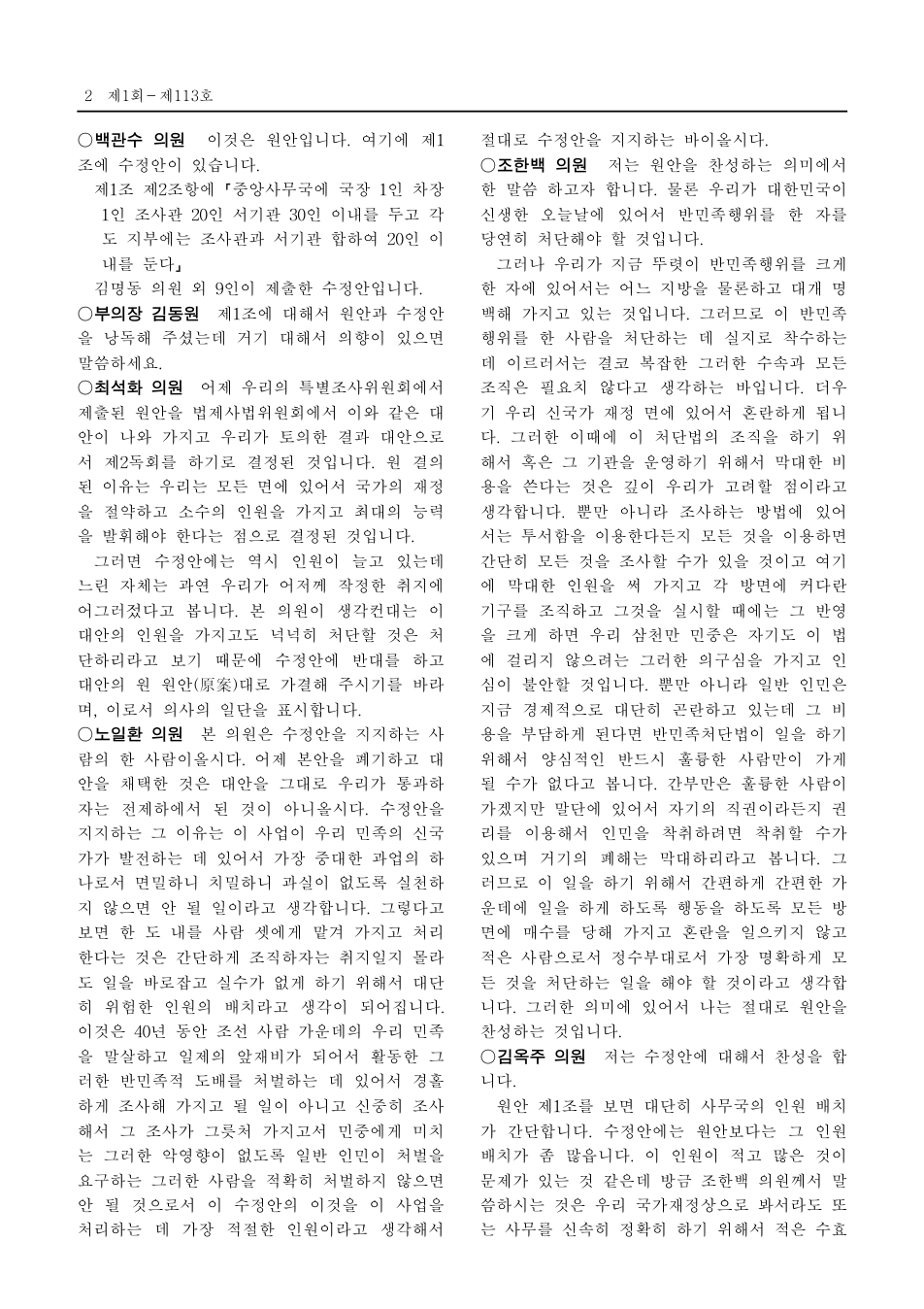
The 113th sitting considered the investigative and trial machinery and began a first reading of amendments. The stenographic record gives the debate its sequence. Proceedings of the 113th Plenary Sitting · Original Korean record
Amendment · Law No. 13
Five instructions modify the original statute. The promulgation date precedes the amendment’s effective date of 28 December. Amendment to the Act on Punishment of Anti-National Acts · Original Korean record
Organization · Law No. 14
Read the central and provincial offices as a structure for investigation. Article 6 specifies investigative powers. Act on the Organization of Special Investigation Agencies for Anti-National Acts · Original Korean record
Organization · Law No. 15
A separate enactment organizes the agencies attached to the Special Tribunal. Read it beside Law No. 14 to distinguish the two functions. Act on the Organization of Attached Agencies of the Special Tribunal · Original Korean record
Committee regulations
The committee’s regulations allocate work inside the organization. The edition discusses a dating anomaly in the printed record. Regulations on the Organization of the Special Investigation Committee for Anti-National Acts · Original Korean record
Repeal · Law No. 55
The repeal concerns the two organizational statutes. Consult the separately printed repeal clauses in the appendices to the editions of Laws Nos. 14 and 15. Act on the Organization of Special Investigation Agencies for Anti-National Acts · Original Korean record
Five amendment instructions
Compare Articles 9, 12, 15, and 26 in the September text with the December instructions. Article 26 receives two changes. The November sitting records an intermediate stage.
What changed on the page?
Select a provision to inspect the effect of its amendment. The passage link opens the wording in Korean and English.
Article 9 · Assembly oversight
The Assembly gains a procedure for a vote of no confidence and re-election of committee members when it considers the committee’s handling of matters contrary to the Act. Read amendment instruction 1.
Article 12 · Access to investigative papers
A member of the Assembly may require the committee or a provincial investigation office to present investigative documents. The amendment gives the document request an institutional setting. Read amendment instruction 2.
Article 15 · Direction of judicial police
An investigating committee member may direct judicial police personnel when an investigation requires it. The wording identifies both the officer exercising the power and its purpose. Read amendment instruction 3.
Article 26(1) · Reconsidering a decision
The new proviso lets the committee request reconsideration of a special prosecutor’s decision through agreement among the special prosecutors. Read amendment instruction 4.
Article 26(2) · Further investigation
The wording substitution explicitly provides for commissioning a committee member to conduct a further investigation. Read it separately from the preceding proviso. Read amendment instruction 5.
From fourteen draft articles to seven enacted articles
The edition of Law No. 14 distinguishes a fourteen-article draft from a seven-article enactment. The November minutes preserve interventions while alternatives were still in play. Cite the printed page for a member’s argument and the enacted article for an office’s legal powers.
Proceedings of the 113th Plenary Sitting · Act on the Organization of Special Investigation Agencies for Anti-National Acts